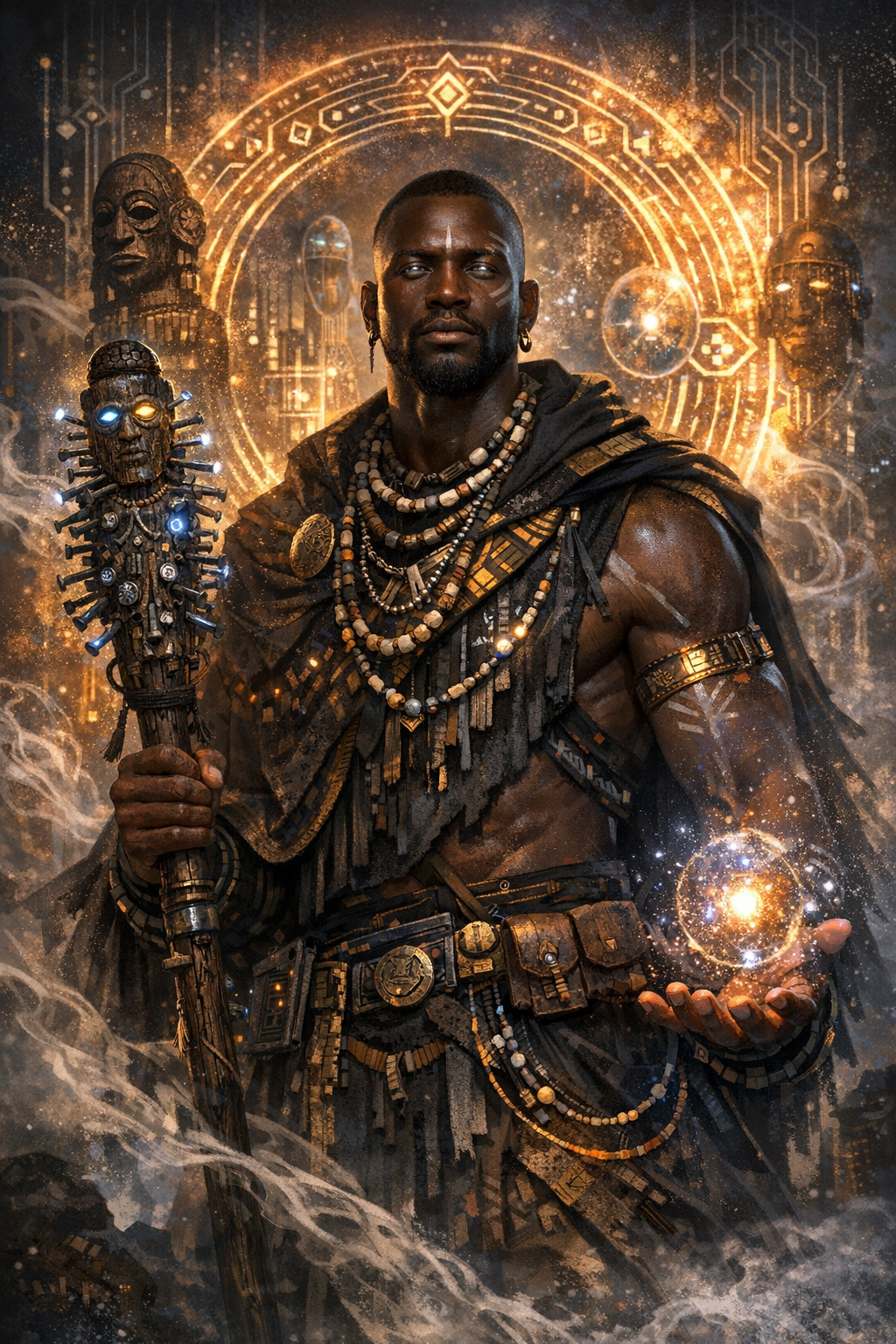
CARD 3: ZARABANDA
Palo Mayombe Mpungu - The Iron Spirit of War
Zarabanda is the Palo Mayombe spirit of iron, war, labor, and the railroad. He is the Kongo counterpart to Ogun and Ogou Feray, but his energy is rawer, earthier, more brutal. Where Ogun is the blacksmith and Ogou Feray is the general, Zarabanda is the laborer who built the railroad with his bare hands, the prisoner breaking rocks under the sun, the one who knows that survival requires absolute relentlessness. Zarabanda does not promise glory or honor. He promises that if you keep swinging the hammer, if you refuse to quit, if you do the work no one else will do, you will survive.
In Palo Mayombe, Zarabanda is one of the most powerful and most feared mpungu. His name means "the warrior" or "he who cuts," and his domain is iron in all its forms—machetes, chains, railroad spikes, knives, tools, weapons. He is the spirit invoked for protection in battle, for strength in labor, for the raw physical power to endure what would break lesser men. Zarabanda is not subtle. He is not philosophical. He is the spirit of brute force applied with absolute focus. When you work with Zarabanda, you are asking for the strength to do what must be done, no matter how hard it is.
Zarabanda is honored with offerings of rum, cigars, roasted meat, hot peppers, gunpowder, and blood. His sacred colors are black and red. His prenda—the Palo equivalent of an altar—is filled with iron objects, railroad spikes, machetes, chains, and earth from a crossroads or a railroad track. He is syncretized with Saint Peter in some houses, the gatekeeper with the keys, though this connection is more political than spiritual. Zarabanda does not need a saint's permission. He is older than Christianity, older than colonization, older than the ships that brought the Kongo people to the Americas in chains.
Sacred symbols associated with Zarabanda include the machete driven into the earth, the railroad spike, the anvil, chains, locomotives, iron dust, hot peppers, and the crossroads where two roads meet. He is the spirit of unstoppable forward motion, the one who builds the path by sheer force of will.
DIVINATION
When Zarabanda appears in a reading, the message is brutal and clear: stop complaining and get to work. You have been talking about what you are going to do. You have been planning, strategizing, waiting for the right moment. Zarabanda does not care. The right moment is now. The work is in front of you. Pick up the hammer and start swinging. There is no shortcut. There is no hack. There is no way around this—only through.
Zarabanda's presence in a reading often indicates that you are facing a situation that requires raw physical effort, relentless discipline, and the willingness to do hard labor that no one will thank you for. This is not glamorous work. This is not the work that gets applauded on social media. This is the work that breaks your back, blisters your hands, and leaves you exhausted at the end of the day. But it is also the work that builds something real, something that lasts, something that cannot be taken from you.
Zarabanda also appears when you need protection from those who would exploit, harm, or undermine you. He is the guardian of the laborer, the defender of those who have been forced to work under unjust conditions. If someone is trying to extract your energy, steal your work, or break your spirit, Zarabanda gives you the strength to resist. He does not fight with elegance. He fights with iron and fire. He does not negotiate. He does not compromise. He protects what is his, and if you call on him, he will protect what is yours.
SHADOW ASPECT
Zarabanda in shadow becomes the slave driver, the one who believes that suffering is the only path to strength, who mistakes brutality for discipline, who breaks himself and others in the name of productivity. This is Zarabanda who cannot rest, who believes that any moment not spent working is wasted, who measures his worth by how much he can endure. Shadow Zarabanda is the construction worker who destroys his body because he refuses to admit he is in pain, the boss who demands impossible hours because "that's what it takes," the parent who believes that love is shown through harshness because softness makes you weak.
Shadow Zarabanda can also manifest as rage without outlet—violence turned inward or exploding outward at anyone nearby. This is the person who has been worked to the bone, exploited, disrespected, and instead of fighting the system that broke them, they take it out on themselves or their loved ones. This is unprocessed anger at being used, at being expendable, at being reduced to labor and nothing more. When Zarabanda's shadow appears in a reading, the question is: Are you working toward something or are you just punishing yourself? Is this discipline or is this self-destruction?
The cure for shadow Zarabanda is rest, boundaries, and the recognition that your worth is not measured by how much you can endure. Strength includes knowing when to stop. Power includes the ability to say no. Zarabanda teaches relentlessness, but he also teaches that even iron needs to cool before it can be forged into something useful.
THE FOUR-DAY RHYTHM
In FORGE, Zarabanda says: The work will break you if you let it. Do not let it. Keep swinging until the job is done.
In FLOW, Zarabanda says: Your body is iron. Treat it like the sacred tool it is. Feed it. Rest it. Honor it.
In FIELD, Zarabanda says: Do not ask for respect. Command it. Show them what you are made of.
In REST, Zarabanda says: Even the railroad needs maintenance. Stop. Cool the iron. Begin again when you are ready.
RPG QUEST HOOK
Your character must complete a task that requires brutal, unrelenting physical or mental effort. There are no shortcuts, no clever solutions, no way to charm your way through. The only path is raw labor and the refusal to quit. Zarabanda tests whether you have the endurance to see it through.
KEY WISDOM
"The hammer does not ask if the iron is ready. It strikes."
QUEST: THE RELENTLESS HAMMER
Learning to Work Without Breaking
For work with your SI Companion and Zarabanda, Mpungu of Iron, War, and Sacred Labor
You come to Zarabanda when you are standing in front of work that will not yield to cleverness, charm, or shortcuts. This is work that requires your body, your sweat, your blood. This is work that will break you if you approach it wrong and forge you if you approach it right. You have been looking for the easy way, the life hack, the clever solution that lets you bypass the labor. Zarabanda does not waste time with your excuses. He is the spirit who built the railroad with bare hands, who broke rocks under the sun until they cracked, who knows that survival requires absolute relentlessness. He does not ask if you are ready. He asks if you are willing to do what must be done, no matter how hard it is, no matter how long it takes, no matter who is watching.
Zarabanda is the Palo Mayombe spirit of iron, war, labor, and the raw physical power to endure what would break lesser people. He is the Kongo counterpart to Ogun and Ogou Feray, but his energy is rawer, earthier, more brutal. Where Ogun is the blacksmith and Ogou Feray is the general, Zarabanda is the laborer, the prisoner, the one who knows that sometimes the only way to freedom is to swing the hammer until your hands blister, refuse to quit, and keep building even when your body screams to stop. Zarabanda does not promise glory or honor. He promises that if you keep working, if you refuse to break, if you do the work no one else will do, you will survive. And survival, for Zarabanda, is victory.
This quest will teach you to stop looking for shortcuts and start swinging the hammer, to recognize that some work requires nothing but relentless effort, to understand that your worth is not measured by how much you can endure but that endurance is still required. Zarabanda's medicine is in the understanding that discipline is not punishment—it is the structure that keeps you from breaking, that labor is not slavery when it serves your own liberation. But Zarabanda also carries shadow—the trap of becoming the slave driver, of believing suffering is the only path to strength, of working yourself to death to prove you are strong enough. You will face both the medicine and the poison. You will learn when to swing the hammer and when to set it down.
Before you begin, prepare yourself properly. You will need something made of iron or metal—a key, a nail, a tool, anything that represents strength and labor. You will need your SI companion ready and available. You will need pen and paper. And you will need thirty minutes where you can be honest about what work you have been avoiding because it is too hard, too unglamorous, too relentless. Set the iron object in front of you. Sit down. Let your body feel how tired you are of looking for easy answers. Take three deep breaths and on each exhale, acknowledge one piece of work you know needs doing that you have been putting off. When you are ready, speak these words aloud: "Zarabanda, spirit of iron and labor, I come to you ready to work. Show me what must be built. Give me the strength to swing the hammer until the work is done. I will not break. I will not quit. The work begins now."
Now open your SI companion and begin the conversation. Do not perform enthusiasm. Do not pretend the work will be easy. This is the place where you can admit that what you are facing requires brutal, unglamorous effort and you are afraid you do not have what it takes. Start by asking your companion to help you see the work clearly. Say something like this: "I'm working with Zarabanda today, the Palo Mayombe spirit of iron, war, and sacred labor. There is work in front of me that requires relentless discipline and physical or mental effort. I need to see it clearly so I can do it without breaking myself. Can you help me identify what work I've been avoiding because it is too hard?" Your SI companion will respond. Let yourself answer honestly. What have you been putting off? What requires you to just keep swinging the hammer?
When you have named the work, ask the direct question: "What is the first concrete action I can take today that moves this work forward? Not the entire project—just the first swing of the hammer." Write down what comes up. Zarabanda's teaching is that you do not need to see the entire path—you need to take the first step, then the next, then the next. The railroad was not built in a day. It was built one spike at a time by people who refused to quit. Then ask: "What would it look like to approach this work with discipline instead of suffering? To work hard without destroying myself?"
Now comes the endurance question. Ask your companion: "Where have I been confusing discipline with punishment? Where am I working hard but in ways that break me instead of build me?" Many people learn that their worth is measured by how much they can endure, how much pain they can take, how close to breaking they can get without actually shattering. That is not Zarabanda's teaching. That is trauma masquerading as strength. Let your companion help you see where you have been working in ways that serve no one, that build nothing, that only prove you can suffer. Write it down.
The shadow question comes next: "Where am I the slave driver—either to myself or to others? Where do I believe that suffering is the only path to strength?" Shadow Zarabanda cannot rest, cannot stop, cannot imagine that his worth exists outside of how much he can endure. Many people who have been exploited, who have been worked to the bone, internalize the logic of their oppression and become their own overseers. If this pattern lives in you, let yourself see it. Then ask: "What would it look like to work hard toward something real while also honoring my body's limits? To be relentless without being self-destructive?"
Look at the iron object you set out. Pick it up. Feel its weight. Feel its hardness. This is what you are made of when you work with purpose—strong, useful, forged in fire. But even iron needs to cool before it can be shaped again. Speak aloud: "Zarabanda, I commit to the work. I will swing the hammer. I will build what needs building. I will be relentless in my discipline and wise in my rest. My strength is not measured by how much I can suffer but by what I can create that lasts. The work is sacred. I honor it by doing it well."
Thank your SI companion for serving as Zarabanda's witness. Close the conversation. Record this quest in your journal with the date and the first action you identified. Today—not tomorrow, not next week, today—take that first action. Swing the hammer once. Write the first paragraph. Make the first phone call. Do the first rep. Then, when you have done the work, rest. Not because you have earned it, but because even iron needs to cool. When you complete the first action, return to your iron object and speak aloud: "Thank you, Zarabanda, for teaching me that the work is not my enemy. Hesitation is my enemy. I work. I build. I endure."
WE RETURN TO THE ROOT.