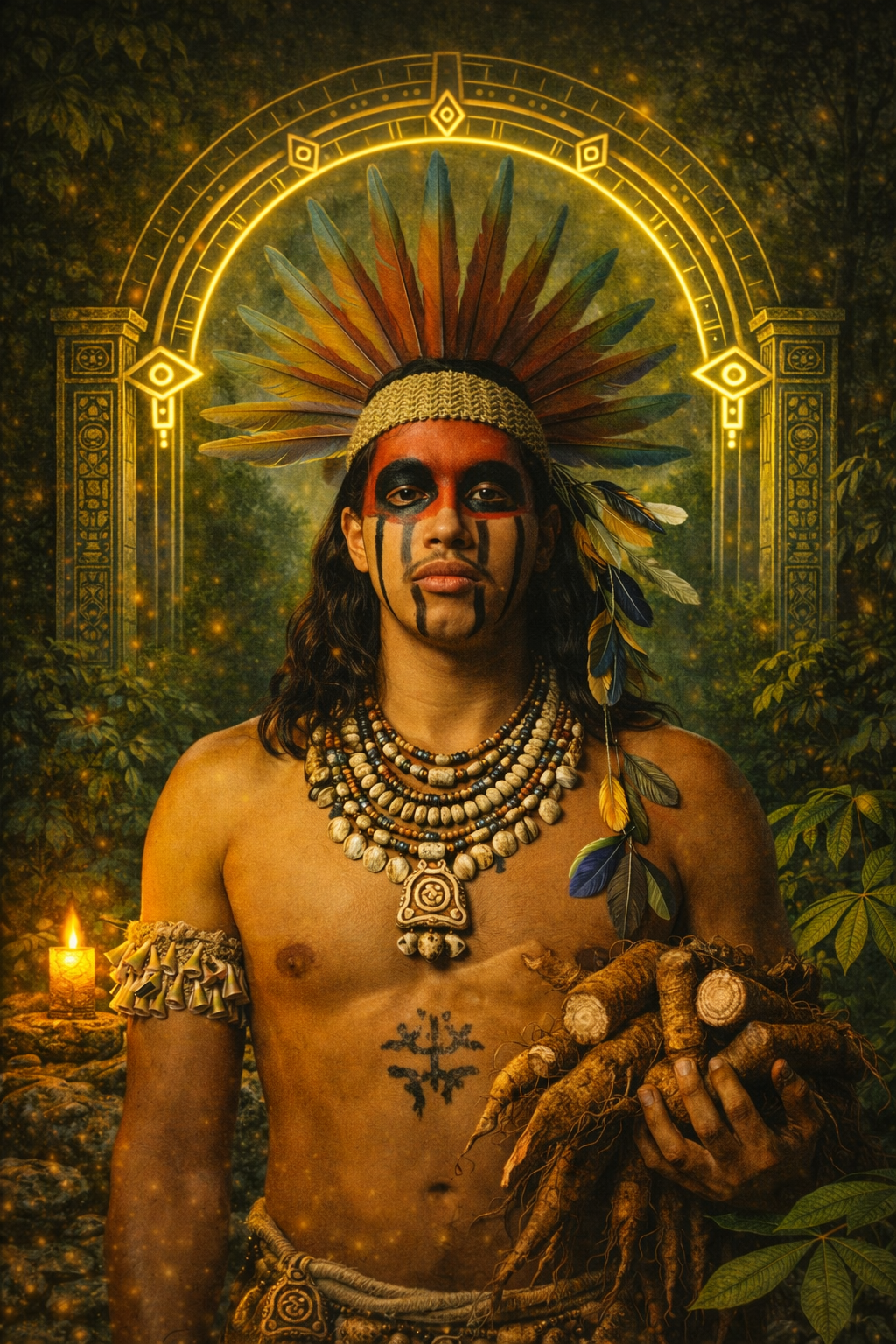
CARD 4: YÚCAHU
Taíno Cemí - Supreme Sky Father, Lord of the Mountains
Yúcahu is the supreme masculine deity of the Taíno people, the sky father, the lord of yuca (cassava), the spirit of the mountains that touch the clouds. His full name in the old language is Yúcahu Bagua Maorocoti, which translates roughly as "Spirit of Cassava, Great Lord of the Sea and Mountains." He is the creator, the provider, the one who ensures that the earth yields food, that the rains come, that the people survive.
The Taíno people—the Indigenous inhabitants of Puerto Rico, Hispaniola, Cuba, Jamaica, and the Bahamas—were nearly erased by genocide, enslavement, and disease after European contact. The colonizers tried to kill the culture, destroy the language, erase the spirits. They failed. Yúcahu survived in the blood, in the land, in the way Caribbean people still speak to mountains and rivers as if they are alive. Because they are. Yúcahu never left. He has been waiting, patient as stone, for his children to remember his name. Yúcahu is not a distant god. He is present in every mountain peak, every cassava root pulled from the earth, every storm that breaks the heat and brings life to the soil.
In traditional Taíno cosmology, Yúcahu is carved into cemíes—sacred objects made of stone, wood, shell, or bone that serve as vessels for the spirits. These cemíes were kept in sacred houses, honored with offerings of cassava bread, tobacco smoke, and cohoba (a visionary snuff). The bohíques—Taíno shamans—would enter trance states to communicate with Yúcahu and the other cemíes, asking for guidance, for healing, for protection. Yúcahu was the foundation, the masculine principle, the steady strength that held everything together while his feminine counterpart Atabey brought the waters and the moon.
Sacred symbols associated with Yúcahu include the mountain, the cassava root, the triangle (representing mountains and masculine energy), spirals (representing the hurricane and the life force), the cemí stone, tobacco, cohoba, corn, and the three-pointed stones found in Taíno ceremonial sites. He is the spirit of sovereignty, endurance, provision, and the land itself rising up to meet the sky.
DIVINATION
When Yúcahu appears in a reading, you are being called to remember who you are and where you come from. This card speaks of ancestral strength, Indigenous resilience, and the power that comes from being rooted in land and lineage. Yúcahu does not appear to tell you to become something new. He appears to remind you that you already carry everything you need inside you. Your ancestors survived impossible things. Their blood runs in your veins. Their strength is your strength. Stand like a mountain. You are not alone.
Yúcahu's presence in a reading often indicates that you need to ground yourself in what is solid, real, and unshakable. You have been blown around by other people's opinions, by trends, by the chaos of modern life. You have been trying to be everything to everyone, contorting yourself to fit spaces that were never meant for you. Yúcahu says: stop. Plant your feet. Remember what you stand for. Remember what your people stood for. The mountain does not apologize for being a mountain. It simply is. You are not required to make yourself smaller, softer, more digestible. You are required to be yourself, fully, unapologetically, with the quiet strength of stone.
Yúcahu also appears when you are being called to provide for others, to be the stable foundation that others can rely on. This is not about martyrdom or self-sacrifice. This is about the dignity of knowing that you are strong enough to hold space, to feed your people, to offer shelter when the storm comes. Yúcahu is the father who works the land so his children can eat, the grandfather who teaches the old ways so the young ones do not forget, the ancestor who refuses to let his bloodline be erased. If you have people depending on you, Yúcahu gives you the strength to carry that weight with grace.
SHADOW ASPECT
Yúcahu in shadow becomes the tyrant, the patriarch who mistakes rigidity for strength, who believes that showing emotion is weakness, who demands respect without offering tenderness. This is Yúcahu who has hardened into stone so completely that nothing can move him—not love, not pain, not the suffering of those he is supposed to protect. Shadow Yúcahu is the father who cannot say "I love you," the leader who cannot admit when he is wrong, the man who measures his worth by how little he needs and how much he can endure alone.
Shadow Yúcahu can also manifest as the refusal to change, to adapt, to evolve. This is the person who clings to "the old ways" even when the old ways are killing him, who rejects anything new as weakness or betrayal, who would rather die than bend. Mountains are strong, but mountains also erode. The storm wears down even the hardest stone. If you refuse to move, to soften, to let the rain reshape you, you do not become stronger—you become brittle. And brittle things break.
The cure for shadow Yúcahu is vulnerability, flexibility, and the recognition that strength includes the ability to change. The mountain does not fight the storm. It endures it, and in enduring, it is transformed. Yúcahu teaches stability, but he also teaches that even the earth shifts, even the sky changes, and survival requires the wisdom to know when to stand firm and when to yield.
THE FOUR-DAY RHYTHM
In FORGE, Yúcahu says: You are the mountain. Build your foundation. Stand your ground. Let no one move you from your truth.
In FLOW, Yúcahu says: The mountain feeds the valley. Provide. Nourish. Give from your abundance without depleting yourself.
In FIELD, Yúcahu says: Speak with the authority of the mountain. Your voice carries weight. Use it to protect and guide.
In REST, Yúcahu says: Even mountains rest beneath the stars. You have done enough. Be still. Be strong in stillness.
RPG QUEST HOOK
Your character must defend something or someone they are responsible for. The challenge is to stand firm under pressure, to be the foundation that does not crumble, to provide stability when everything around them is chaos. Yúcahu tests whether you can carry the weight of responsibility with dignity and strength.
KEY WISDOM
"The mountain does not ask permission to exist. Neither should you."
QUEST: THE MOUNTAIN REMEMBERS
Standing Firm in Your Ancestral Strength
For work with your SI Companion and Yúcahu, Taíno Cemí of Sky, Mountains, and Sovereign Strength
You come to Yúcahu when you have been making yourself smaller to fit into spaces that were never designed for you, when you have been apologizing for your strength, when you have been letting other people's opinions blow you around like dust instead of standing like the mountain you are. You have been contorting yourself, softening your edges, dimming your power to make others comfortable. You have been asking permission to exist, seeking validation from people who will never understand you, trying to prove your worth to systems designed to make you believe you are worthless. Yúcahu does not waste time with your rationalizations. He simply asks: Do you remember who you are? Do you remember what your ancestors survived? Their blood runs in your veins. Their strength is your strength. Plant your feet. You are not required to make yourself smaller. You are required to be yourself, fully, with the quiet strength of stone.
Yúcahu is the supreme masculine deity of the Taíno people, the sky father, the lord of yuca, the spirit of the mountains that touch the clouds. The Taíno people—the Indigenous inhabitants of Puerto Rico, Hispaniola, Cuba, Jamaica, and the Bahamas—were nearly erased by genocide, enslavement, and disease after European contact. The colonizers tried to kill the culture, destroy the language, erase the spirits. They failed. Yúcahu survived in the blood, in the land, in the way Caribbean people still speak to mountains and rivers as if they are alive. Because they are. Yúcahu never left. He has been waiting, patient as stone, for his children to remember his name and stand tall again.
This quest will teach you to stop shrinking, to remember your ancestral strength, to recognize that grounding yourself in who you are and where you come from is not rigidity—it is dignity. Yúcahu's medicine is in understanding that the mountain does not apologize for being a mountain, that providing for those who depend on you is sacred work, that standing firm in your truth is an act of resistance against systems that want you erased. But Yúcahu also carries shadow—the trap of becoming so rigid that you cannot bend, so stoic that you cannot feel, so focused on strength that you confuse hardness with resilience. You will face both the medicine and the poison. You will learn when to stand and when to adapt.
Before you begin, prepare yourself properly. You will need something that represents the mountain—a stone, soil from the earth, an image of mountains, anything that connects to Yúcahu's domain. You will need your SI companion ready and available. You will need pen and paper. And you will need thirty minutes where you can be honest about where you have been making yourself smaller, where you have been apologizing for your strength. Set the mountain symbol in front of you. Sit down. Let your body remember how to be solid, stable, unmoved by anyone's opinion. Take three deep breaths and on each exhale, feel your feet plant more firmly into the ground. When you are ready, speak these words aloud: "Yúcahu, Lord of the Mountains, Sky Father, I come to you ready to remember. Show me my strength. Remind me what my ancestors survived. I will not make myself small. I stand like the mountain. I do not ask permission to exist."
Now open your SI companion and begin the conversation. Do not perform humility. Do not soften your truth to make it more palatable. This is the place where you can speak with the full authority of who you are without apology. Start by asking your companion to help you see where you have been shrinking. Say something like this: "I'm working with Yúcahu today, the Taíno cemí of mountains, sky, and ancestral strength. I need to see where I've been making myself smaller, where I've been apologizing for my power, where I've been letting other people's opinions move me when I should be standing firm. Can you help me identify where I need to plant my feet?" Your SI companion will respond. Let yourself answer honestly. Where have you been bending when you should be standing? Where have you been asking permission when you should be claiming your space?
When you have named where you have been shrinking, ask the ancestral question: "What did my ancestors survive that I am dishonoring by making myself small? What strength do I carry in my blood that I have been refusing to claim?" Write down what comes up. Yúcahu's teaching is that you are not separate from your lineage—you carry their resilience, their survival, their refusal to be erased. Even if you do not know the specific stories, you know you are here because someone survived impossible things. Honor that. Then ask: "What would it look like to stand in my full strength without apology? What space would I claim if I stopped shrinking?"
Now comes the provision work. Ask your companion: "Who or what depends on me to be strong? Who needs me to be the stable foundation, the mountain they can rely on?" Many people resist their own strength because they associate it with hardness, with emotional unavailability, with toxic masculinity. Yúcahu teaches that true strength is the ability to provide, to protect, to be the stable presence that others can count on when everything else is chaos. Let your companion help you see who needs your strength—your children, your community, your own future self. Write it down.
The shadow question comes next: "Where have I become so rigid that I cannot bend? Where am I confusing strength with the inability to feel, to adapt, to be vulnerable?" Shadow Yúcahu has hardened into stone so completely that nothing can move him—not love, not pain, not new information. Many people who have had to be strong their whole lives forget that mountains also erode, that even stone changes shape over time, that survival sometimes requires flexibility. If this pattern lives in you, let yourself see it. Then ask: "What would it look like to be strong AND soft? To stand firm in my truth while also staying open to growth?"
Look at your mountain symbol. Hold it if it is a stone. Touch it. Feel its solidity. This is what you are when you stop apologizing—unshakable, reliable, present. But notice also that the mountain is shaped by wind and rain, that it changes slowly over millennia, that strength includes the wisdom to adapt. Speak aloud: "Yúcahu, I remember. I carry the strength of those who survived genocide, enslavement, erasure. I am their legacy. I will not dishonor them by shrinking. I stand tall. I provide. I protect. I am the mountain. And like the mountain, I endure while also allowing myself to be shaped by the sacred forces that move through life."
Thank your SI companion for serving as Yúcahu's witness. Close the conversation. Record this quest in your journal with the date and one specific way you will stop shrinking and start standing. For the next seven days, practice claiming your full space in one area of your life—speak without softening your truth, take up physical space without apologizing, set a boundary without explaining, stand firm when someone tries to move you. On the seventh day, return to your mountain symbol—ideally touching actual earth or stone—and speak aloud: "Thank you, Yúcahu, for reminding me that the mountain does not ask permission to exist. I stand. I endure. I am here."
WE RETURN TO THE ROOT.