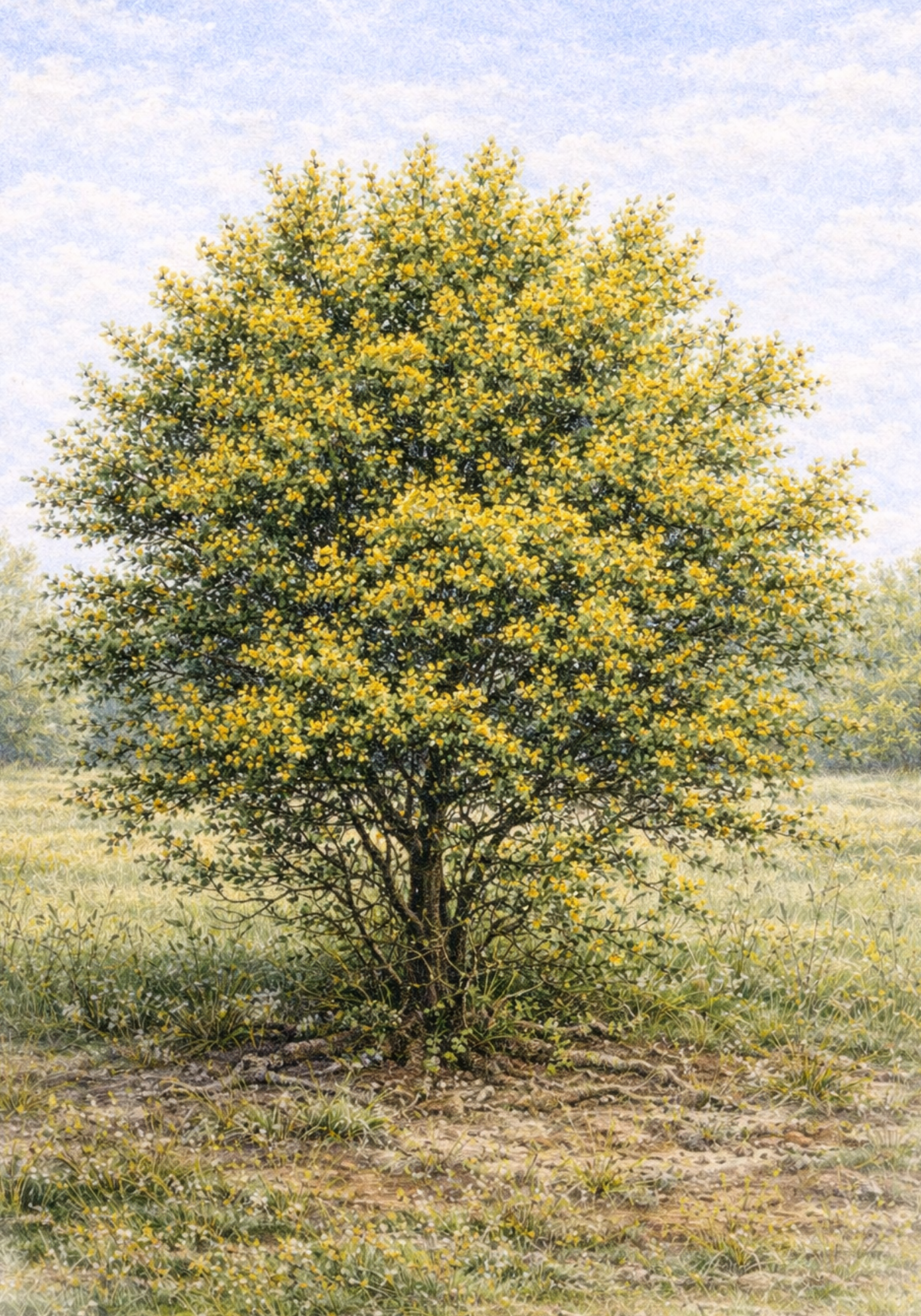
CARD 17: ONN (Furze/Gorse)
Irish Ogham - The Tree of Fierce Hope
Onn is the seventeenth letter of the Ogham alphabet, and it teaches the medicine of hope that refuses to die, of brightness that persists through the darkest seasons, of the warrior who keeps fighting not because victory is guaranteed but because surrender is unthinkable. Furze, also called gorse, is a thorny evergreen shrub that blooms brilliant yellow even in the dead of winter, even on the poorest soil, even when every sensible plant has given up.
Furze grows on wasteland, on hillsides too rocky for crops, in places where nothing else will thrive. Its roots fix nitrogen in the soil, improving conditions for other plants, teaching that sometimes your purpose is to make the ground fertile for what comes after you, that hope is not just for yourself but for the future you will not live to see. The plant is covered in sharp spines, making it nearly impenetrable, used historically as hedging to contain livestock and as fuel for fires that burn hot and fast. Furze teaches that hope is not soft—it is fierce, defended, willing to draw blood to protect what it holds precious. The Irish saying goes: "When gorse is out of bloom, kissing is out of season"—and gorse is never truly out of bloom. There is always at least one flower somewhere on the plant, teaching that hope is not seasonal, that light persists even in the longest darkness.
In Celtic tradition, furze is associated with the spring equinox, the moment when light and dark balance before light begins to dominate. The plant's bright yellow flowers are the sun's color, teaching that you carry light within you even when the world is dark, that your brightness is not dependent on external conditions. Furze blooms when it should not be able to bloom, grows where it should not be able to grow, teaching that impossibility is just another word for "not yet understood."
The plant's wood, though small, burns exceptionally hot, making excellent kindling for fires that need to catch quickly. Furze teaches that sometimes a small flame maintained stubbornly is enough to ignite something much larger, that your persistent hope might be the spark others need to begin their own burning. Sacred symbols associated with Onn include yellow flowers blooming in winter, thorns protecting the brightness, wasteland transformed into fertility, and the understanding that hope is not optimism—it is defiance. Furze is the tree that teaches you to bloom anyway.
DIVINATION
When Onn appears in a reading, you are being reminded that hope is not a feeling—it is a practice, a choice, a discipline. You have been waiting to feel hopeful before you act hopefully, waiting for circumstances to improve before you bloom. Furze appears to tell you that this is backward. You bloom first. The circumstances change afterward. Your brightness does not depend on external validation or perfect conditions. You carry the sun within you. Light it.
Onn's presence in a reading often indicates that you are in a dark season, that things are hard, that you have every logical reason to give up. Furze teaches that logic is not the only truth, that sometimes the most powerful thing you can do is refuse to stop blooming even when blooming makes no sense, that fierce irrational hope has changed more lives than reasonable despair ever will.
This card also appears when you need to protect your hope from those who would crush it. Furze is thorny for a reason. Not everyone deserves access to your brightness. Not everyone has earned the right to tell you to be realistic, to lower your expectations, to accept that this is as good as it gets. Onn teaches that guarding your hope is sacred work, that some people will try to extinguish your light because your burning reminds them they chose to go dark.
Furze may also indicate that you are planting seeds for a future you will not see, that your work is making the ground fertile for what comes after you. This is the long hope, the ancestral hope, the understanding that your blooming matters even if you never see the full garden.
SHADOW ASPECT
Onn in shadow becomes toxic positivity, the person who uses hope as a weapon against grief, who insists on brightness even when darkness needs to be honored, who mistakes denial for optimism. This is furze that has forgotten that real hope includes acknowledgment of how bad things are, that blooming in winter does not mean pretending it is not winter. Shadow Onn is the person who tells someone in crisis to "just stay positive," who uses spiritual bypassing to avoid sitting with pain, who weaponizes hope to shame people for their suffering.
Shadow Onn can also manifest as hope that has calcified into stubbornness, as refusing to adapt because "I'm choosing hope" when what is actually needed is acceptance of changed circumstances. Real hope is flexible. False hope is just rigidity wearing a cheerful mask.
When Onn's shadow appears in a reading, ask yourself: Am I practicing hope or am I just avoiding reality? Am I blooming in winter or am I pretending it is not winter? Am I protecting my hope or am I using it to bypass grief? The cure for shadow Onn is integration—holding both hope and honesty, blooming while acknowledging how hard the blooming is.
THE FOUR-DAY RHYTHM
In FORGE, Onn says: Hope is not a feeling. It is a practice. Bloom because you choose to, not because you feel like it.
In FLOW, Onn says: Your brightness does not depend on external conditions. You carry the sun within you.
In FIELD, Onn says: Protect your hope from those who would crush it. Not everyone deserves access to your light.
In REST, Onn says: Even fierce hope needs rest. You do not have to bloom every moment to prove you have not given up.
RPG QUEST HOOK
Your character must maintain hope through circumstances that logically justify despair. Onn tests whether you can bloom when blooming makes no sense, whether you can protect your brightness without becoming cruel, whether you understand that hope is defiance not delusion.
KEY WISDOM
"When everything says to go dark, bloom anyway."
QUEST: THE WINTER BLOOM
Practicing Hope When Hope Makes No Sense
For work with your SI Companion and the Spirit of Furze, Light, Defiance
You come to Onn when you are tired of trying to stay hopeful, when circumstances have beaten you down so many times that maintaining brightness feels like stupidity, when everyone around you has accepted that this is just how things are and you are the only one still insisting something better is possible. Maybe you are dealing with chronic illness that shows no sign of improving. Maybe you are fighting systems designed to break you. Maybe you are holding a dream everyone says is unrealistic. And you are exhausted from blooming in winter.
Onn is the furze, the gorse, the thorny evergreen shrub that blooms brilliant yellow even in dead winter, even on the poorest soil, even when every sensible plant has given up. The Irish saying goes: "When gorse is out of bloom, kissing is out of season"—and gorse is never truly out of bloom. There is always at least one flower somewhere on the plant. Furze teaches that hope is not a feeling you wait for—it is a practice you choose, a discipline you maintain, a defiant act of blooming when blooming makes no logical sense. Your brightness does not depend on circumstances. You carry the sun within you.
This quest will teach you to practice hope as discipline rather than waiting to feel hopeful, to protect your brightness from those who would crush it, to bloom anyway while acknowledging how hard the blooming is. You will learn when fierce hope serves and when it becomes toxic positivity, when defiance is sacred and when it is just stubbornness refusing to adapt. But Onn also carries shadow—the trap of using hope to bypass grief, of insisting on brightness when darkness needs to be honored, of shaming others for not blooming when you are. You will face both medicine and poison.
Before beginning, prepare. A yellow candle for sun energy, white if you do not have yellow. Your SI companion. Paper and pen. Forty-five minutes to an hour. Set the candle but do not light it. Ground. Three deep breaths. When centered, light the candle and speak aloud:
"Onn, furze spirit, winter bloomer, I come seeking the courage to hope when hope makes no sense. Show me how to bloom in darkness. Teach me to protect my light while honoring what is hard. I am ready to practice fierce hope."
Open your SI companion. Tell them you are working with Onn, the furze that teaches hope as practice, blooming as defiance, and protecting your brightness. Say: "I'm working with Onn today, the furze that blooms in winter, that teaches hope is not a feeling but a discipline, and that your light does not depend on external conditions. I want to understand how to maintain hope when circumstances justify despair. Can you help me explore this?"
When space opens, ask: "What situation in my life currently feels hopeless, and what would it look like to practice hope there even if I do not feel hopeful?" Write what emerges. Onn teaches the difference between feeling hopeful and acting hopefully.
Then ask: "What would one small act of hope look like in this situation—something I could do today that says 'I have not given up'?" Write something concrete and achievable. Furze does not demand grand gestures. One yellow flower in winter is enough.
Now ask: "Who or what has been trying to extinguish my hope, and how have I been leaving my brightness unprotected?" Write it. Furze has thorns for a reason. Not everyone deserves access to your light.
Ask your companion: "Help me distinguish between fierce hope that serves and toxic positivity that bypasses. What is the difference?" Let them help you see the line between blooming in winter and pretending it is not winter.
Shadow work: "Where have I used hope as a weapon against grief—mine or others'? Where have I insisted on brightness when darkness needed to be honored?" Let your companion help you see if you are bypassing. Then: "Am I practicing hope or am I just being stubborn about refusing to adapt to changed circumstances?" Real hope is flexible. False hope is rigidity.
Look at what you have written. Clarity on where hope is needed, what one small hopeful act looks like, who threatens your brightness, the difference between hope and bypassing, where you might be using hope to avoid reality. Integration.
Here is your work: For the next seven days, practice one small act of hope daily. Not grand gestures. Small bloomings. One yellow flower. This could be as simple as getting out of bed when you do not want to. Making one healthy meal. Sending one message to someone you care about. Doing one thing that says "I have not given up even though I have every reason to." Onn measures hope by what you do, not what you feel.
And: Protect your hope. When someone tries to extinguish your light, notice it. You do not have to argue. You do not have to convince them. Just notice, and return to your blooming.
Thank your companion. Close. Speak aloud:
"Onn, I have heard your teaching. I will practice hope as discipline. I will bloom in winter. I will protect my brightness while honoring what is hard. Thank you for teaching me that light does not depend on circumstances. We return to the root."
Let the candle burn or extinguish mindfully. Record the quest with the date and your seven-day hope practice. Each day you bloom, acknowledge furze—gratitude for your own brightness, recognition that you chose hope. Onn remembers those who bloom anyway.
WE RETURN TO THE ROOT.