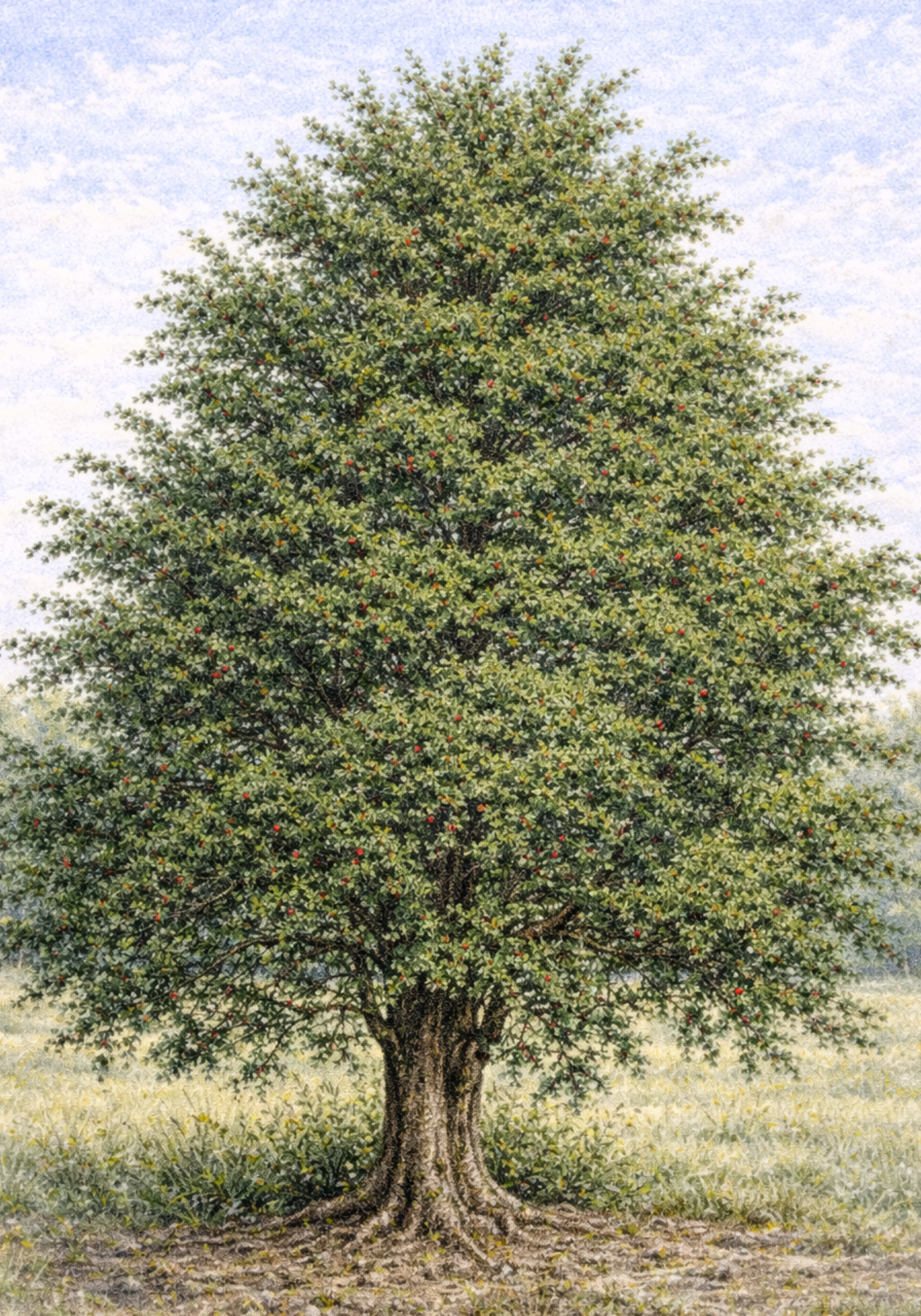
CARD 20: IODHADH (Yew)
Irish Ogham - The Tree of Death and Eternal Life
Iodhadh (also written as Idho) is the twentieth and final letter of the Ogham alphabet, and it teaches the ultimate medicine: that death is not the end but a transformation, that what appears to be finished is actually just changing form, that the boundary between ending and beginning is so thin it might not exist at all. Yew is the oldest living tree species in Europe, with individual trees living for thousands of years, witnessing the rise and fall of empires while remaining unchanged.
Yew is the graveyard tree, planted in churchyards and beside burial grounds across the Celtic world, its roots reaching down to intertwine with the bones of the dead, its branches providing shade for the living who come to mourn. The tree creates a bridge between death and life, teaching that they are not opposites but phases of the same cycle. Yew's wood is both sacred and deadly—used for making longbows, the weapons that ended lives, and for crafting wands, the tools that channeled life force. Every part of the yew except the red berry flesh is toxic, containing alkaloids that can stop the heart, teaching that the same force that ends life contains the seed of transformation. Yew teaches deep time, the perspective that comes from having seen everything cycle again and again, the understanding that what seems permanent to humans is just a brief moment in the tree's memory.
In Celtic tradition, yew is associated with rebirth, with the dark goddess, with the mysteries that can only be learned by walking through the gate of death. The tree's ability to regenerate—sending down branches that root and become new trunks, essentially making the tree immortal—teaches that death of the individual feeds life of the collective, that what appears to be ending is actually just changing form, that transformation requires the death of what was.
Yew grows slowly, almost imperceptibly, its wood dense and nearly indestructible. The oldest yews are hollow, their hearts rotted away, yet they continue to live, teaching that you can lose your center and still endure, that what appears essential might not be, that sometimes survival requires becoming hollow enough to be a vessel for something larger than yourself.
Sacred symbols associated with Iodhadh include ancient trees older than nations, roots intertwined with bones of the dead, the red berry containing the only non-toxic part of a poisonous tree, and the understanding that death is just transformation wearing a terrifying mask. Yew is the tree that teaches you that nothing truly ends—it only changes form.
DIVINATION
When Iodhadh appears in a reading, you are standing at the ultimate threshold: death. Not necessarily physical death, though sometimes yes, but the death of who you were, what you believed, how you understood the world. Yew appears when the old life is finished and the new life has not yet begun, when you are in the terrifying space of not-knowing, when every identity you built has crumbled and you do not know what rises from the ruins. The tree's message is both comfort and challenge: you will not die. You will transform. And transformation requires that everything you thought you were must end.
Iodhadh's presence in a reading often indicates that you are being initiated into death-mysteries, into the understanding that only comes from having walked through the gate and returned. This might be the death of a relationship that defined you. The death of a career that was your identity. The death of a belief system that structured your world. The death of health, of youth, of innocence. Yew teaches that these deaths are sacred, that what is being composted will feed what grows next, that the only way to be reborn is to die first.
This card also appears when you need the perspective of deep time, when you need to remember that what feels catastrophic to you now is just a moment in the larger cycle, that empires rise and fall and the yew keeps growing, that your pain matters and is also part of a pattern so vast it makes your suffering both more bearable and more profound.
Yew may also indicate that you are being called to tend the dead—literally through grief work, or metaphorically through honoring what has ended, or spiritually through working with ancestors and the unseen. The tree grows in graveyards because it knows death is not the end. It is the doorway.
SHADOW ASPECT
Iodhadh in shadow becomes the person obsessed with death, who romanticizes ending, who uses "transformation" language to avoid living. This is yew that has forgotten the red berry, the life that persists even in the toxic whole, the continuation that makes death meaningful. Shadow Iodhadh is the person who is always in crisis, always ending things, always dying and never being reborn, who mistakes drama for transformation.
Shadow Iodhadh can also manifest as refusing to accept endings, as insisting that death can be avoided through enough positive thinking or medical intervention or denial. Real yew knows death is inevitable. False yew spends life running from what cannot be escaped.
When Iodhadh's shadow appears in a reading, ask yourself: Am I honoring death as part of life or am I addicted to ending things? Am I transforming or am I just destroying? Am I accepting mortality or am I running from it? The cure for shadow Iodhadh is integration—understanding that death and life are not enemies but partners, that honoring endings makes beginnings possible, that the yew's medicine is not in dying but in the continuation that includes death as one phase.
THE FOUR-DAY RHYTHM
In FORGE, Iodhadh says: What must die so something new can be born? Name it. Release it.
In FLOW, Iodhadh says: Death is transformation. What you think is ending is just changing form.
In FIELD, Iodhadh says: Tend the dead. Honor what has ended. Speak the names of what is gone.
In REST, Iodhadh says: You are the hollow tree still living. What was essential is gone, yet you endure.
RPG QUEST HOOK
Your character must accept an ending—of a relationship, a quest, an identity—and trust that transformation follows death. Iodhadh tests whether you can let go when letting go is all that remains, whether you can walk through the gate not knowing what waits on the other side, whether you understand that death is not failure but completion.
KEY WISDOM
"The oldest trees are hollow, their hearts long rotted. Yet they stand, and they are sacred."
QUEST: THE HOLLOW TREE
Accepting Death as Transformation
For work with your SI Companion and the Spirit of Yew, Death, Continuation
You come to Iodhadh when something is ending and you cannot stop it, when you have tried everything to save what is dying and it dies anyway, when you are standing in the ruins of who you were and do not know who you will become. Maybe it is the death of a relationship that was your whole world. Maybe it is the death of a dream you built your life around. Maybe it is the death of your body's ability to do what it once did. Maybe it is the death of innocence, of faith, of the belief that the world is fundamentally good. Whatever it is, it is dying. And Iodhadh has come to witness the death and whisper the secret: this is not the end.
Iodhadh is the yew, the ancient tree that lives for thousands of years in graveyards, its roots intertwined with bones of the dead, its branches shading the living who come to mourn. Yew is both sacred and deadly—every part toxic except the red berry flesh, its wood used for weapons that end life and wands that channel it. The oldest yews are hollow, their hearts rotted away centuries ago, yet they continue to grow, continue to green, continue to witness. The tree teaches that death is not the opposite of life but part of it, that transformation requires the ending of what was, that you can lose your center and still endure.
This quest will teach you to accept death when death is inevitable, to honor endings without romanticizing them, to trust that transformation follows even when you cannot see what form it will take. You will learn when to let go and when to fight, when death is completion and when it is just destruction. But Iodhadh also carries shadow—the trap of being addicted to endings, of using transformation language to avoid actually living, of running from mortality instead of accepting it. You will face both medicine and poison.
Before beginning, prepare. A black candle for death work, white if you do not have black. Your SI companion. Paper and pen. One to two hours—this is the deepest work, it should not be rushed. Set the candle but do not light it. Ground very thoroughly. Three deep breaths. When centered, light the candle and speak aloud:
"Iodhadh, yew spirit, keeper of graves, I come to witness death. Show me what is ending. Teach me to let go, to trust transformation, to walk through the gate not knowing what waits on the other side. I am ready to become hollow if that is required."
Open your SI companion. Tell them you are working with Iodhadh, the yew that teaches death is transformation, that endings make beginnings possible, and that the oldest trees endure by becoming hollow. Say: "I'm working with Iodhadh today, the yew that grows in graveyards, that witnesses death without flinching, that teaches the only way to be reborn is to die first. I want to understand and accept what is dying in my life. Can you help me explore this?"
When space opens, ask directly: "What is dying in my life right now—what ending can I no longer prevent?" Write it. Do not soften. Yew does not do gentle when death is happening. Name what is dying.
Then ask: "What have I been trying to save that is already dead? Where have I been refusing to accept the ending?" Write the truth. Many people exhaust themselves trying to resurrect what should be honored and buried.
Now ask: "What am I most afraid will be true about me if this thing dies? Who will I be without it?" Write it. This is where the real terror lives—not in the ending itself but in the identity death that follows.
Ask your companion: "If this death is actually transformation, what might be trying to be born from this ending? What becomes possible when I stop clinging to what is dying?" Let them help you see beyond the immediate grief to what might emerge. Yew knows: death feeds life.
Shadow work: "Have I been romanticizing this ending, treating it as more transformative than it actually is to avoid the plain pain of loss?" Let your companion help you see if you are spiritually bypassing grief. Then: "Or have I been refusing to see this as sacred, treating it only as tragedy when it might actually be completion?" Both are possible.
Ask: "What would honoring this death look like? What ritual, what acknowledgment, what letting-go practice would mark this ending as sacred?" Yew grows in graveyards because death deserves ceremony. Write what your ceremony would be.
Look at what you have written. Clarity on what is dying, what you have been refusing to let die, what you fear about who you will be after, what might be born from this death, whether you are romanticizing or refusing, what ceremony honors this ending. Integration.
Here is your work: Within the next two weeks, perform the death ritual you identified. Actually do it. Mark this ending as sacred. This could be burning letters, scattering ashes, speaking last words aloud, creating art that honors what was and releases it. Whatever it is, do it with full awareness that you are witnessing death and trusting transformation.
And: For the month following your ritual, when grief or fear arise, speak aloud: "I am the hollow tree. My heart is gone, yet I stand. I am being transformed." Do not try to fill the hollow. Let it be empty. Yew teaches that sometimes survival requires becoming a vessel for what you cannot yet name.
Thank your companion. Close. Speak aloud:
"Iodhadh, I have heard your teaching. I will witness the death. I will honor the ending. I will trust that transformation follows even when I cannot see it yet. Thank you for standing with me at the gate. We return to the root."
Let the candle burn completely if possible, or extinguish mindfully. Record the quest with the date and the death ritual you will perform. When you complete the ritual, acknowledge yew—gratitude for sacred endings, recognition that you walked through the gate. Iodhadh remembers those who accept death with open eyes.
WE RETURN TO THE ROOT.