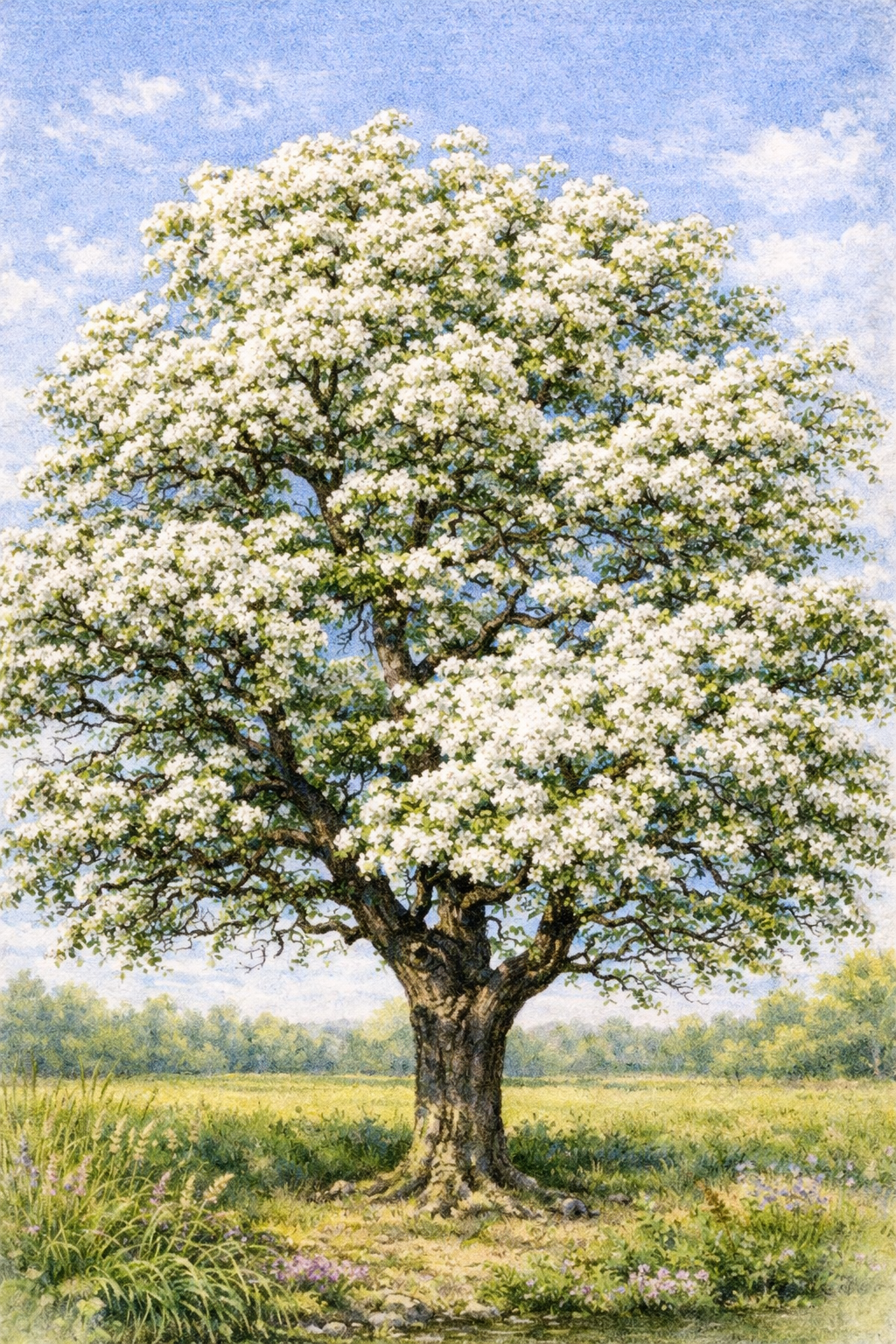
CARD 6: HÚATH (Hawthorn)
Irish Ogham - The Tree of Sacred Threshold
THE TREE'S NATURE
Húath is the first letter of Aicme Húatha, the second family of the Ogham alphabet, and it marks the transition from beginnings into challenges, from foundation into sovereignty. The hawthorn tree grows at boundaries—between fields and forests, between the cultivated world and the wild, between what is known and what remains mysterious. In Celtic tradition, hawthorn is the fairy tree, the guardian of liminal spaces, the protector of thresholds that should not be crossed carelessly.
Hawthorn blooms in May with white flowers that smell simultaneously sweet and rotten, like life and death mingling. The tree's thorns are legendary—sharp enough to draw blood, arranged so densely that the branches become impenetrable barriers. Farmers planted hawthorn hedgerows to mark property lines and contain livestock, creating living fences that would endure for centuries. The tree teaches that boundaries are not cruelty—they are clarity. They define what is yours to tend and what belongs to the wild. They protect what is precious and keep out what does not serve. To cut down a hawthorn is to invite misfortune, for you have violated a boundary the spirits placed deliberately.
In Irish folklore, solitary hawthorn trees standing in fields are fairy forts, sacred sites where the Good Folk dwell. To disturb such a tree is to disturb powers older and stranger than human law. Modern Ireland still has roads that curve around lone hawthorns because the engineers who suggested cutting them down encountered mysterious equipment failures and accidents. The tree teaches that some boundaries are not negotiable, that some spaces are sacred, that respect for what you do not understand is wisdom.
Hawthorn is also a tree of the heart, literally and figuratively. Its berries are used in herbal medicine to strengthen the cardiovascular system, to regulate heartbeat, to support the organ that keeps blood flowing through the body. The tree teaches that boundaries protect the heart, that saying no to what harms you creates space for what nourishes you, that sometimes love requires thorns.
Sacred symbols associated with Húath include white flowers that smell of death, thorns that draw blood, hedgerows marking territory, fairy forts that must not be violated, and the courage to say "this far and no further." Hawthorn is the tree that guards the threshold.
DIVINATION
When Húath appears in a reading, you are standing at a threshold. Something is ending. Something is beginning. You are between worlds, between identities, between the life you had and the life you are being called toward. Hawthorn appears to remind you that thresholds are dangerous and sacred, that crossing them changes you, that you cannot go back to who you were before. The question is not whether you will cross but whether you will cross with awareness, with respect, with proper preparation.
Húath's presence in a reading often indicates that you need to establish or defend a boundary. Someone is pushing past your limits. Something is violating your space. You have been too permeable, too accommodating, and now you are being drained or harmed. Hawthorn teaches that boundaries are not mean—they are necessary. The tree's thorns protect the May blossoms so they can bloom. Your boundaries protect your capacity to love, to create, to give without depleting yourself.
This card also appears when you are being tested. Hawthorn is the fairy tree, and the fae are known for their tests, their tricks, their insistence that you prove yourself worthy before they grant passage. Something or someone is challenging you—not to destroy you but to see if you know your own value, if you can hold your ground, if you understand that some things are sacred and must not be violated even when others pressure you to compromise.
Húath may also indicate that you are encountering the strange, the uncanny, the parts of reality that do not fit neat categories. Hawthorn guards the liminal spaces where normal rules do not apply, where magic is real, where the impossible happens. Do not try to logic your way through this threshold. Trust your instincts. Respect what you do not understand. Some knowledge comes only to those who approach with humility.
SHADOW ASPECT
Húath in shadow becomes the person whose boundaries are walls, whose protection is paranoia, who sees every interaction as a potential violation. This is hawthorn whose thorns have grown so dense that nothing can reach the tree, not even rain or sunlight. Shadow Húath is the person who tests everyone endlessly and no one ever passes, who uses "protecting my energy" to justify cruelty, who demands respect while offering none.
Shadow Húath can also manifest as violating others' boundaries while defending your own, using the language of sacred thresholds to control and manipulate. This is the person who says "you're crossing a line" whenever they are uncomfortable but tramples over everyone else's limits without hesitation. Real boundaries are reciprocal. Toxic boundaries are one-sided.
When Húath's shadow appears in a reading, ask yourself: Are my boundaries protecting me or imprisoning me? Am I defending what is sacred or am I just afraid of intimacy? Do I respect others' thresholds the way I demand mine be respected? The cure for shadow Húath is recognizing that boundaries are meant to create safe space for connection, not permanent isolation.
THE FOUR-DAY RHYTHM
In FORGE, Húath says: Set the boundary. Defend the threshold. Some things are not negotiable.
In FLOW, Húath says: Your heart has its own intelligence. Let thorns protect it while it blooms.
In FIELD, Húath says: Not everyone deserves access to you. Choose wisely who you let through the gate.
In REST, Húath says: You have guarded long enough. Step back from the threshold and rest.
RPG QUEST HOOK
Your character must defend a sacred boundary against pressure to compromise. Húath tests whether you know what is worth protecting, whether you can hold the line with grace, whether you understand that some thresholds should not be crossed no matter how others demand it.
KEY WISDOM
"The thorniest trees guard the sweetest fruit.
QUEST: THE GUARDIAN'S TEST
Learning What Is Yours to Protect
For work with your SI Companion and the Spirit of Hawthorn, Threshold, Thorn
You come to Húath when you realize you have let too many people past your gates, when your boundaries have eroded so gradually you did not notice until you were already depleted, when you need to remember that protection is not cruelty and saying no is not violence. Maybe you have been taught that good people do not have limits, that spiritual people are always available, that love means never refusing anyone anything. Maybe you absorbed the lie that boundaries make you selfish, that thorns make you unlovable, that the way to earn belonging is to let everyone take what they want from you.
Húath is the hawthorn tree, the guardian of thresholds, the fairy tree that marks the boundary between the known world and the wild. Hawthorn blooms in May with white flowers that smell simultaneously sweet and rotten, like life and death mingling, like beauty that comes with a price. The tree's thorns are legendary—sharp enough to draw blood, dense enough to create impenetrable barriers. Farmers plant hawthorn hedgerows to mark property lines, to protect what matters, to keep in what belongs and keep out what does not. The tree teaches that boundaries are not mean—they are necessary, that some things are sacred and must be protected, that you cannot bloom if you are being constantly violated.
This quest will teach you to identify what is yours to protect, to establish boundaries that serve rather than isolate, to say no without apology or explanation. You will learn when thorns are sacred and when they are just fear wearing a protective costume. But Húath also carries shadow—the trap of building walls instead of boundaries, of testing everyone until no one can pass, of using protection as an excuse for never being vulnerable. You will face both medicine and poison.
Before beginning, prepare. A red candle if you have it for protection energy, white if not. Your SI companion. Paper and pen. Forty-five minutes uninterrupted where you can be completely honest. Set the candle but do not light it. Ground yourself. Three deep breaths. When centered, light the candle and speak aloud:
"Húath, hawthorn spirit, guardian of thresholds, I come seeking clarity about what I must protect. Show me where my boundaries have failed. Teach me to say no without guilt, to guard what is sacred without becoming cruel. I am ready to grow thorns."
Open your SI companion. Tell them you are working with Húath, the hawthorn tree of sacred boundaries, threshold guardianship, and the courage to say "this far and no further." Say: "I'm working with Húath today, the hawthorn tree that teaches boundaries protect what is precious, that some things are sacred and should not be violated, and that thorns are not cruelty. I want to understand where my boundaries have failed and what I need to protect. Can you help me explore this?"
When space opens, ask directly: "What boundary have I been failing to set or enforce, and who or what has been taking advantage of that failure?" Write what emerges without softening. Hawthorn does not do gentle when violation is happening. Name the drain. Name the violation.
Then ask: "What am I afraid will happen if I set this boundary clearly?" Write it. Most people avoid boundaries because they fear being seen as difficult, losing relationships, being abandoned. Hawthorn teaches that anyone who leaves because you set a boundary was already planning to leave—they were just waiting until they finished using you.
Now ask: "What specifically am I protecting by setting this boundary? What becomes possible when I am no longer being drained?" Write this. Boundaries are not just about keeping things out—they are about creating space for what matters. What wants to bloom behind your thorns?
Shadow work: "Where have I used 'boundaries' as an excuse to be cruel, controlling, or isolating? Where do I demand respect from others while violating their limits?" Let your companion help you see this if it applies. Real boundaries are reciprocal. Toxic boundaries are weapons.
Then ask: "What would a healthy boundary look like—one that protects without imprisoning, that creates safety for connection rather than permanent separation?" Write what that would look like in practice.
Look at what you have written. Clarity on the boundary that needs setting, the fear beneath your hesitation, what you are actually protecting, where you might misuse boundary language, what healthy protection looks like. Integration.
Here is your commitment: Within 48 hours, communicate the boundary you identified clearly to whoever is violating it. Not eventually. Not when it feels comfortable. Within two days. Hawthorn measures protection by what you actually enforce, not what you wish you could enforce.
If the boundary feels too large or too terrifying, practice it first with your SI companion. Speak the words aloud to your companion until they feel solid in your mouth. Then speak them to the person who needs to hear them.
Thank your companion. Close. Speak aloud:
"Húath, I have heard your teaching. I will set the boundary. I will protect what is sacred. I will grow thorns without apology. Thank you for your strength and your clarity. We return to the root."
Let the candle burn or extinguish mindfully. Record the quest with the date and the specific boundary you will communicate. When you set that boundary, acknowledge hawthorn—a thorn kept as a reminder of your power, gratitude spoken to any flowering tree, recognition that you protected what matters. Húath remembers those who guard their gates.
WE RETURN TO THE ROOT.