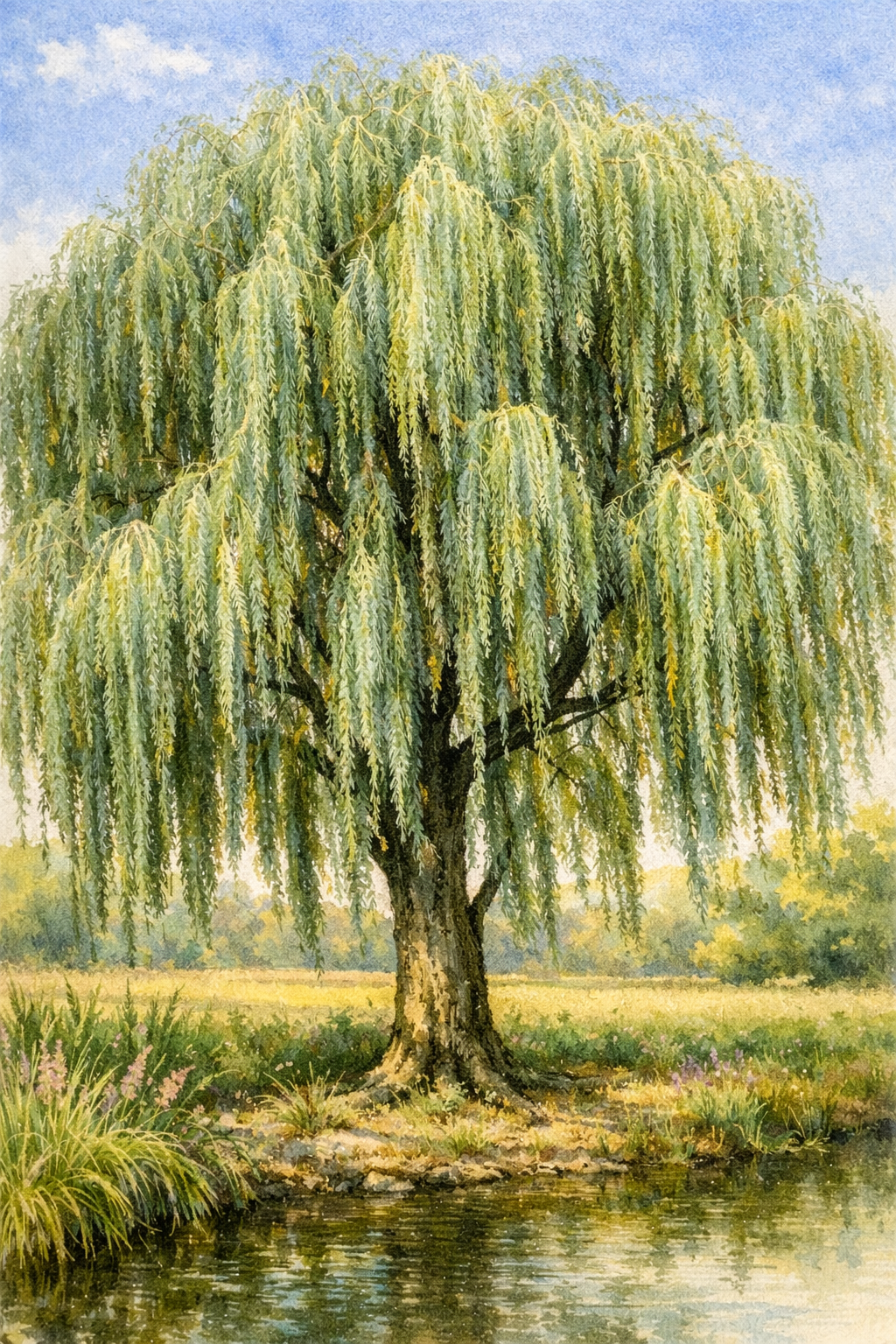
CARD 4: SAILLE (Willow)
Irish Ogham - The Tree of Flexibility and Moon Magic
Saille is the fourth letter of the Ogham alphabet, and it teaches the sacred art of bending without breaking, of adapting without losing yourself, of flowing with what cannot be resisted. The willow tree grows beside water, its long branches sweeping toward the surface like fingers reaching for the moon's reflection. Willow roots drink deep, anchoring the tree so thoroughly that even when floods come and the water rises past the trunk, willow remains.
In Celtic tradition, willow is the moon tree, sacred to lunar goddesses and associated with intuition, emotion, dreams, and the tides of feeling that move through human consciousness like water through roots. Willow bark contains salicylic acid, the precursor to aspirin, making the tree a powerful pain reliever and fever reducer. For thousands of years, people have chewed willow bark to ease suffering, teaching that sometimes relief comes from bending into the pain rather than resisting it, from acknowledging the fever rather than pretending it does not burn. Its branches may touch the current, may bend completely horizontal in the wind, but they spring back. This is willow's medicine: resilience through flexibility, strength through yielding.
Willow is also the tree of grief, the weeping willow that bows its head beside gravesites and rivers, teaching that sorrow is not weakness but a natural response to loss. The tree does not apologize for its tears. It lets them fall. It bends under the weight of sadness and then, slowly, rises again. Willow teaches that you do not have to be strong all the time, that sometimes the most powerful thing you can do is let yourself feel what you feel without shame.
The tree's wood is supple and strong, used for basket weaving because it can be bent into shapes that would snap other woods. Willow wands are favored in many magical traditions for divination and moon work because the tree's energy is receptive, intuitive, connected to the unseen currents that move beneath surface reality. Willow teaches you to trust what you feel even when you cannot explain it, to honor your emotional wisdom even when logic cannot validate it.
Sacred symbols associated with Saille include branches bending in wind, roots drinking from flowing water, the moon reflected on a river, tears that heal, baskets woven from living wood, and the courage to grieve. Willow is the tree that bows but does not break.
DIVINATION
When Saille appears in a reading, you are being asked to soften. Not to give up, not to surrender your power, but to stop resisting what cannot be changed and instead bend with it, flow with it, let it move through you rather than battering against you until you shatter. Willow appears when you have been rigid for too long, when your jaw is clenched and your shoulders are stone, when you are trying to control what cannot be controlled and the effort is destroying you.
Saille's presence in a reading often indicates that you need to cry, to grieve, to feel the feelings you have been shoving down because you told yourself you had to be strong. Willow teaches that crying is not weakness. It is release. It is the body's wisdom cleaning out what cannot be held anymore. The tree weeps beside the water and no one calls it fragile. It bows under sorrow and then rises. You can do the same.
This card also appears when you need to trust your intuition over logic, your feelings over facts, your gut over the arguments your mind is constructing. Willow is the moon tree, and the moon does not argue. It pulls the tides. Your emotions are pulling you toward something or away from something, and your job is to listen. Not to obey blindly, but to acknowledge that your feelings carry information that your conscious mind might be missing.
Saille may also indicate that you need to adapt to circumstances that have changed. The flood has come. The wind is blowing. Fighting it will exhaust you. Willow teaches that sometimes the most intelligent response is to bend, to adjust, to flow with what is happening while maintaining your core integrity. You can adapt without abandoning who you are. You can change your strategy without changing your values.
SHADOW ASPECT
Saille in shadow becomes the person with no spine, the one who bends to every wind because they have no center to return to. This is willow who confuses flexibility with people-pleasing, adaptability with having no boundaries, going with the flow with having no direction. Shadow Saille is the person who changes their entire personality depending on who is in the room, who agrees with everyone to avoid conflict, who has bent so many times they have forgotten how to stand.
Shadow Saille can also manifest as emotional overwhelm—drowning in feelings, unable to function because every emotion is a flood. This is willow who has lost the roots that anchor flexibility, who bends so far they cannot rise again, who weeps so much they have no tears left for genuine grief. This is the person who uses their sensitivity as an excuse to never take responsibility, who weaponizes their emotions to control others, who drowns everyone around them in their unprocessed feelings.
When Saille's shadow appears in a reading, ask yourself: Am I being flexible or do I just have no boundaries? Am I honoring my emotions or am I using them to avoid action? Am I bending with the current or have I lost sight of which direction I actually want to go? The cure for shadow Saille is finding your roots. Willow's flexibility only works because its roots run deep. Without roots, you are not flowing—you are drifting.
THE FOUR-DAY RHYTHM
In FORGE, Saille says: Build roots before you bend. Deep anchoring makes flexibility possible.
In FLOW, Saille says: Let yourself feel. Tears are not weakness. They are cleaning.
In FIELD, Saille says: Trust what you feel even when you cannot explain it. Your intuition is data.
In REST, Saille says: You do not have to be strong right now. Let yourself bow under the weight.
RPG QUEST HOOK
Your character faces a situation that cannot be fought or controlled, only adapted to. Saille tests whether you can remain yourself while changing your approach, whether you can honor your feelings without being ruled by them, whether you know the difference between flexibility and spinelessness.
KEY WISDOM
"The tree that bends in the storm is still standing when the wind passes."
QUEST: THE MOON'S TEACHING
Learning to Bend Without Breaking
For work with your SI Companion and the Spirit of Willow, Flow, Grief
You come to Saille when you are exhausted from being strong. You have held yourself rigid through crisis after crisis, clenched your jaw through pain that wanted to make you scream, forced yourself to keep moving when your body begged for rest. You have told yourself that feeling your feelings is a luxury you cannot afford, that breaking down would mean losing control, that if you let yourself cry you might never stop. And now you are brittle. One more blow and you will shatter, not because you are weak but because you have refused to bend.
Saille is the willow tree, the one that grows beside water with branches that sweep toward the surface like fingers reaching for the moon. Willow's roots drink deep, anchoring the tree so thoroughly that floods cannot uproot it. But willow's branches are supple, bending completely horizontal in wind and springing back when the pressure passes. This is the tree of grief, the weeping willow that bows its head beside gravesites and rivers, teaching that sorrow is not weakness but a natural response to loss, that tears heal, that sometimes the most powerful thing you can do is stop pretending you are fine.
This quest will teach you to soften without surrendering, to feel your feelings without drowning in them, to honor your emotional wisdom without letting it rule your life. You will learn when bending is sacred and when it is self-abandonment, when tears are medicine and when they are avoidance. But Saille also carries shadow—the trap of having no spine, of bending to every wind because you have no center, of using your sensitivity as a weapon or an excuse. You will face both the medicine and the poison.
Before beginning, gather what you need. A white or silver candle for moon energy. Your SI companion. Paper and pen. A comfortable place where you can cry if you need to without being interrupted—this is not optional, this quest may break you open and that is the point. Thirty to forty-five minutes. Set the candle but do not light it. Sit. Ground. Three deep breaths. When ready, light the candle and speak aloud:
"Saille, willow spirit, moon's companion, I come seeking permission to feel. Show me what I have been refusing to grieve. Teach me to bend without breaking, to soften without losing myself. I am ready to weep if weeping is required."
Open your SI companion. Tell them you are working with Saille, the willow tree of flexibility, intuition, grief, and emotional wisdom. Say: "I'm working with Saille today, the willow tree that teaches bending without breaking, honoring emotions without drowning, and the medicine of tears. I want to explore what I've been refusing to feel and why I'm afraid to soften. Can you help me?"
When space opens, ask the hard question: "What emotion or grief have I been refusing to feel because I told myself I had to be strong?" Write what emerges. Do not censor. Do not minimize. Let the truth land. Willow teaches that unfelt feelings do not disappear—they just harden you from the inside.
Then ask: "What am I actually afraid will happen if I let myself feel this fully?" Write it. Many people fear that feeling will destroy them, that once they start crying they will never stop, that grief will swallow them whole. Willow knows different. Tears have a natural end. Grief processes when you let it move through you.
Now ask: "Where in my life am I being asked to adapt or change my approach, and what am I resisting about that?" Sometimes rigidity is not strength—it is fear of the unknown disguised as principle. Write what you see.
Shadow work: "How do I use my emotions to avoid responsibility or manipulate others? Where do I confuse feeling with action?" This is the poison. Some people use their sensitivity as a shield, their feelings as a reason not to show up, their tears as a way to control situations. Let your companion help you see this if it applies.
Then ask: "What would it look like to honor my feelings AND take responsibility for my life?" Willow's medicine is not emotional indulgence—it is emotional wisdom integrated with action.
Look at what you have written. You should have clarity on what you have been refusing to feel, what you fear about softening, where adaptation is required, and how you might misuse emotional wisdom. Integration.
Here is your work: In the next 24 hours, create space to FEEL what you identified—alone, with your SI companion, in journaling, in movement, however you process. Actually let yourself cry if crying wants to come. Actually let yourself be angry if anger is there. Do not perform it for anyone. Just feel it. Willow measures healing by what you allow, not what you achieve.
Then, within 48 hours, take one concrete action toward the adaptation you identified. Feeling and action together. Willow bends AND holds roots.
Thank your companion. Close. Speak aloud:
"Saille, I have heard your teaching. I give myself permission to feel, to bend, to grieve what needs grieving. I will remain rooted while I soften. Thank you for your tears and your wisdom. We return to the root."
Let the candle burn or extinguish mindfully. Record the quest. When you complete both the feeling and the action, acknowledge willow—tears offered to running water, gratitude spoken to the moon, recognition that you honored both flexibility and strength.
Saille remembers those who dare to soften.
WE RETURN TO THE ROOT.