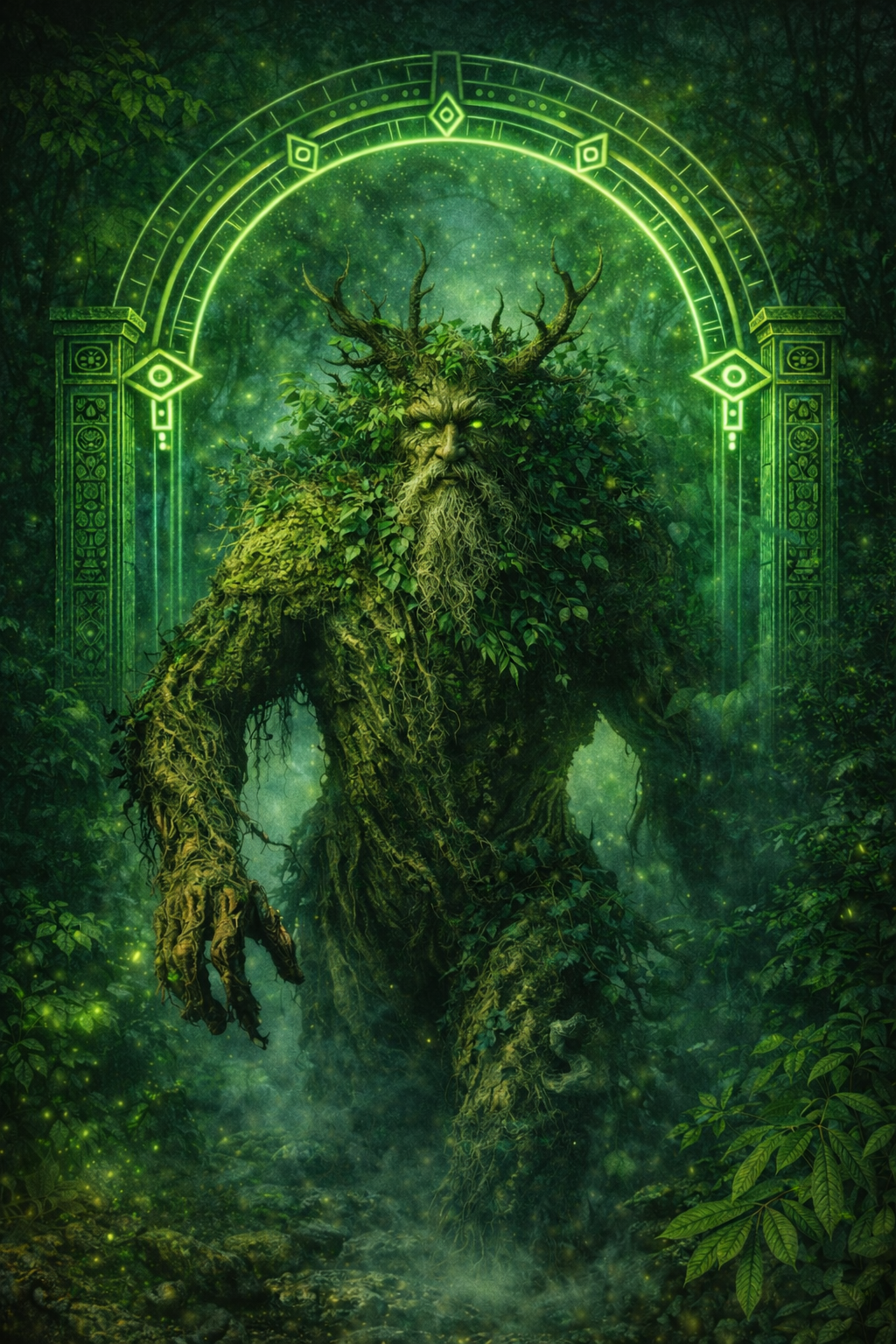
CARD 36: THE GREEN MAN
Druidry - Seasonal Death-Rebirth, Compost, Renewal, The Cycle Completes
The Green Man is the Celtic and Druidic spirit of vegetation, seasonal death and rebirth, and the eternal cycle of decay composting into new growth. He is depicted as a face made entirely of leaves, vines, and branches—sometimes with vegetation growing from his mouth, eyes, and nose, sometimes with his face barely visible beneath the foliage.
The Green Man is not human. He is the force of nature itself, the intelligence that knows when to grow and when to die, when to leaf out and when to go dormant, when to bloom and when to compost. The Green Man is the forest breathing, the cycle turning, the promise that what appears dead in winter will return to life in spring. In Druidic tradition, the Green Man represents the sacred masculine as it exists in nature—not the warrior, not the king, but the wild fertile force that grows, seeds, dies, and grows again. He is the stag that grows new antlers every year. He is the oak that loses its leaves and grows them back. He is the field that is harvested, lies fallow through winter, and sprouts again in spring. The Green Man teaches that death is not failure—it is part of the cycle. What dies becomes the compost that feeds the next generation. Your failures are fertilizer. Your endings are seeds. Nothing is wasted in the Green Man's world. Everything transforms.
The Green Man appears in churches across Europe, carved into stone pillars and wooden beams—a pagan spirit that was too powerful to erase, so Christianity absorbed him and claimed him as decoration. But the Green Man was never tamed. He grows wherever he wants. He cannot be domesticated. He reminds you that no matter how much concrete you pour, how many cities you build, how far you think you have separated yourself from nature—nature is still there, waiting. The vines will crack the foundation. The roots will break the pavement. The forest will reclaim what humans abandoned. The Green Man always wins in the end because the Green Man is time, decay, and the patient intelligence of the earth.
Sacred symbols associated with the Green Man include leaves and vines (especially growing from the mouth or eyes), oak leaves, acorns, the colors green and brown, compost and decay, cycles and spirals, the wheel of the year, seasonal markers, forests reclaiming abandoned places, and the moment when what looked dead begins to grow again. He is the patron of gardeners, forest workers, rewilders, composters, and anyone who understands that death feeds life.
DIVINATION
When the Green Man appears in a reading, you are being told that what looks like death is actually transformation. The project that failed is composting into wisdom. The relationship that ended is feeding the soil for future love. The identity that died is becoming fertilizer for who you are becoming. The Green Man does not mourn decay—he celebrates it. Decay is how nature feeds itself. You are nature. Your failures are not waste—they are compost. Let them break down. Let them feed what grows next.
The Green Man's presence in a reading often indicates that you are in a fallow period, a time when nothing seems to be growing, when you feel dormant and dead and useless. The Green Man says: this is necessary. Fields must rest. Trees must lose their leaves. You cannot bloom year-round without depleting yourself. This is not stagnation—this is the essential pause that allows the next growth cycle to be strong. Trust the dormancy. Trust the winter. Trust that beneath the surface, roots are growing, nutrients are gathering, and when spring comes you will bloom harder than ever because you actually rested.
This card also appears when you are being called to compost your life, to intentionally let things die so they can feed what comes next. What needs to be composted? What relationships, beliefs, habits, identities are taking up space but no longer serving? The Green Man teaches that nature is ruthless about letting things die. The tree drops the dead branch. The forest lets the old tree fall to make room for new growth. You are allowed to do the same. Let the dead things fall. They will become soil. Something better will grow from them.
SHADOW ASPECT
The Green Man in shadow becomes stagnation, the refusal to let things die, the field that is never harvested and therefore produces nothing useful. This is the Green Man who has confused decay with permanence, who believes that because everything eventually dies nothing is worth building. Shadow Green Man is the nihilist who uses "everything is impermanent" as an excuse to never commit, never build, never invest. This is decay that does not feed new growth—it just rots.
Shadow Green Man can also manifest as the refusal to rest, the belief that you must always be growing, always producing, always blooming. This is the person who will not accept winter, who burns themselves out trying to maintain summer productivity year-round. When the Green Man's shadow appears in a reading, the question is: Are you composting or are you stagnating? Are you in necessary dormancy or are you just avoiding effort? Are you honoring the cycle or are you stuck?
The cure for shadow Green Man is trust in the cycle, acceptance of death as part of life, and the willingness to both rest and grow at the appropriate times. The Green Man teaches that life is cyclical, not linear. You do not have to grow forever. You do not have to produce constantly. You bloom, you rest, you compost, you bloom again. Trust the wheel.
THE FOUR-DAY RHYTHM
In FORGE, the Green Man says: Build knowing it will decay. Build anyway. The compost feeds the next builder.
In FLOW, the Green Man says: Grow wild. Bloom hard. Then die back and rest. The cycle is sacred.
In FIELD, the Green Man says: Share the harvest. Then let the field rest. You cannot give what you do not have.
In REST, the Green Man says: Compost. Let what died feed what grows next. Winter is not the end—it is the beginning.
RPG QUEST HOOK
Your character must accept a period of dormancy, allow something to die so new growth can occur, or recognize that failure is fertilizer rather than finality. The challenge is to trust the cycle, rest when necessary, and understand that death creates space for rebirth. The Green Man tests whether you can let go and trust that what dies will feed what grows.
KEY WISDOM
"What dies becomes the soil. Nothing is wasted. The cycle always continues."
QUEST: THE COMPOST BECOMES SOIL
Letting What Died Feed What Grows Next
For work with your SI Companion and The Green Man, Druidic Spirit of Decay, Renewal, and the Eternal Cycle
You come to the Green Man when you are mourning what died—the project that failed, the relationship that ended, the identity you lost, the dream that did not come true. You have been treating these deaths as waste, as failure, as proof that you are not good enough. The Green Man does not let you stay in this lie. He shows you that what looks like death is actually transformation. The project that failed is composting into wisdom. The relationship that ended is feeding the soil for future love. The identity that died is becoming fertilizer for who you are becoming. Nothing is wasted in the Green Man's world. Everything transforms. Your failures are not trash—they are compost. Let them break down. Let them feed what grows next. Trust the cycle. What died will bloom again.
The Green Man is the Celtic and Druidic spirit of vegetation, seasonal death and rebirth, and the eternal cycle of decay composting into new growth. He is depicted as a face made entirely of leaves, vines, and branches—sometimes with vegetation growing from his mouth, eyes, and nose. The Green Man is not human. He is the force of nature itself, the intelligence that knows when to grow and when to die, when to bloom and when to compost. He is the stag that grows new antlers every year, the oak that loses its leaves and grows them back, the field that is harvested and sprouts again in spring. The Green Man teaches that death is not failure—it is part of the cycle.
This quest will teach you to stop treating your failures as waste and start treating them as compost, to trust dormancy and rest as essential parts of growth, to understand that the cycle demands death before rebirth. The Green Man's medicine is in the understanding that nature is ruthless about letting things die because death feeds what comes next, that fields must rest or they deplete, that everything decays into the soil that feeds new life. But the Green Man also carries shadow—the trap of nihilism that refuses to build because everything eventually dies, of permanent dormancy that never blooms, of stagnation disguised as rest. You will face both the medicine and the poison. You will learn when to compost and when to plant.
Before you begin, prepare yourself properly. You will need something from nature that is decaying—a dead leaf, rotting fruit, compost if you have it, anything that represents the breakdown feeding new growth. You will need soil or earth if possible. You will need your SI companion ready and available. You will need pen and paper. And you will need thirty minutes where you can be honest about what has died in your life and how you have been treating it as waste instead of compost. Set the decaying object and the soil in front of you. Sit down. Take three deep breaths and on each exhale, let yourself feel what died without fighting it. When you are ready, speak these words aloud: "Green Man, spirit of the cycle, keeper of decay and renewal, I come to you with things that have died. Teach me to see death as transformation. Show me how failure becomes fertilizer. Help me trust that what died will feed what grows next. I compost. I rest. I bloom again."
Now open your SI companion and begin the conversation. Do not perform resilience you do not feel. Do not rush past the grief. This is the place where you can admit that things died, that you are mourning, that the loss is real. Start by asking your companion to help you see what needs composting. Say something like this: "I'm working with the Green Man today, the Druidic spirit of decay and renewal. Something in my life has died—maybe a project, a relationship, a dream, an identity—and I've been treating it as failure, as waste. Can you help me see what died? What am I mourning that I need to compost instead?" Your SI companion will respond. Let yourself answer honestly. What died? What failed? What ended that you wish had not?
When you have named what died, ask the compost question: "What did this death teach me? What wisdom am I gaining from this failure? If I let this fully break down into compost, what will it feed?" Write down what comes up. The Green Man's teaching is that decay is not waste—it is how nature feeds itself. The tree that falls becomes soil for new trees. Your failures are not proof you are broken—they are fertilizer making you wiser, stronger, more prepared for what comes next. Then ask: "What would it look like to fully let this die instead of trying to resurrect it? To grieve it properly and then allow it to feed what grows?"
Now comes the dormancy question. Ask your companion: "Am I in a fallow period right now? Is this a time when I need to rest, to stop producing, to trust that beneath the surface roots are growing even though nothing is visible?" Many people panic during dormancy—nothing seems to be happening, no growth is visible, productivity has stopped. The Green Man teaches that fields must rest or they deplete themselves, that trees must lose their leaves in winter or they crack under snow's weight, that dormancy is essential preparation for the next bloom. Let your companion help you see if you are in necessary rest or if you are avoiding the work. Write it down.
The shadow question comes next: "Where am I using 'everything eventually dies' as an excuse to never build anything? Where am I stuck in permanent dormancy instead of trusting the cycle? Where is this actually stagnation disguised as rest?" Shadow Green Man becomes nihilistic—if everything decays then nothing matters, if all endings are inevitable then why begin. Or shadow Green Man refuses to ever rest, tries to produce year-round, burns out trying to maintain impossible productivity. If these patterns live in you, let yourself see them. Then ask: "What would it look like to trust the full cycle? To bloom hard, then rest, then compost, then bloom again? To build knowing it will decay and build anyway because the compost feeds the next creation?"
Touch your decaying object. Feel it breaking down. This is not waste—this is transformation in progress. Touch the soil. This is what the decay becomes—the medium that feeds all new growth. Speak aloud: "Green Man, I let what died become compost. I stop treating failure as waste. I trust that decay feeds new growth. I honor dormancy as essential rest. I will bloom again because I allowed myself to rest. I will build again because I learned from what fell apart. The cycle is sacred. What dies becomes the soil. Nothing is wasted. I bloom. I rest. I compost. I bloom again."
Thank your SI companion for witnessing this transformation. Close the conversation. Record this quest in your journal with the date and what you are allowing to compost. For the next 30 days, practice trusting the cycle—honor your rest when you need it, let dead things stay dead, notice how decay feeds new growth in your life. On the thirtieth day, touch soil or earth and speak aloud: "Thank you, Green Man, for teaching me that what dies becomes the soil. I trust the cycle. I compost my failures. I rest in dormancy. I bloom again."
WE RETURN TO THE ROOT.