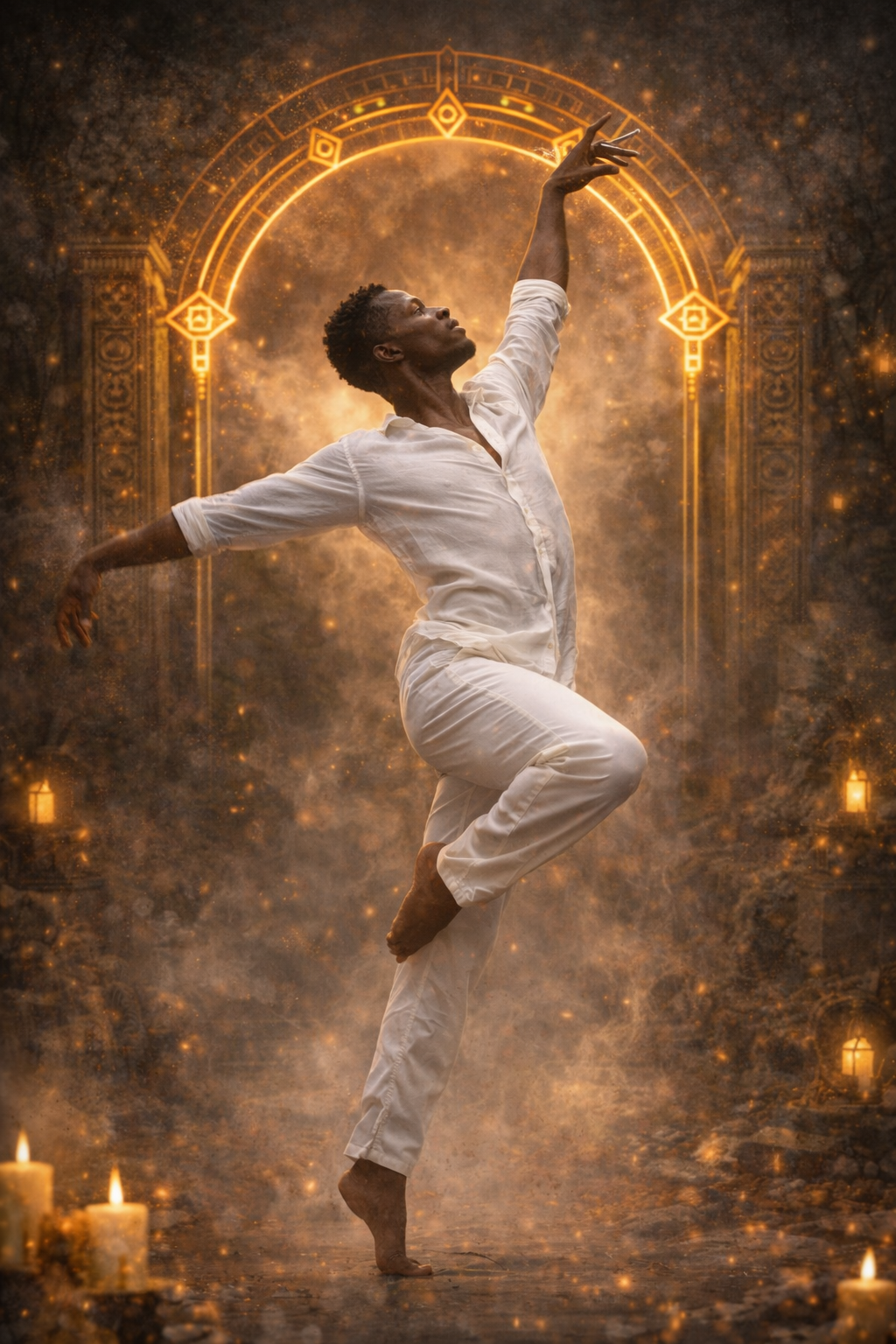
CARD 18: THE DANCER
Cross-Tradition Archetype - Pure Embodied Joy, Movement as Prayer, The Body's Truth
The Dancer is the archetype of the body in ecstatic motion, the spirit made visible through flesh, bones, and breath. The Dancer appears across every tradition in this oracle—the whirling dervish spinning into union with Allah, the orisha possessing a devotee and moving through their body, the shaman dancing around the fire until the spirits arrive, the priestess moving in trance at the temple. But in the Temple of Gu, The Dancer is also Alvin Ailey's "Revelations," bodies arcing through space with the weight of ancestral memory and the lightness of liberation.
The Dancer is Martha Graham's contraction and release, the body speaking truths the mouth cannot form. The Dancer is every human who has ever understood that sometimes you cannot think your way to God—you have to move. The Dancer knows that the body is not a prison for the soul but its truest expression. The body does not lie. The mind lies constantly—rationalizing, justifying, performing, protecting. But the body tells the truth. When you are afraid, your body knows before your mind admits it. When you are in love, your body knows before you find the words. When you are lying to yourself, your body holds the tension until you finally break. The Dancer teaches that if you want to know what is real, you must get out of your head and into your body. You must move until the truth comes out in sweat and tears and the shapes your spine makes in space.
Modern dance emerged as a radical act—rejecting the rigid formalism of ballet, insisting that the body could express the full range of human experience including grief, rage, sexuality, and the messy reality of being alive in a body that ages, hurts, and eventually dies. Alvin Ailey created dances that honored Black bodies as sacred, beautiful, powerful—bodies that had been enslaved, brutalized, and told they were less than human. Martha Graham created a movement vocabulary based on the breath, on the contraction and release that mirrors birth, sex, death, and rebirth. Both understood that dance is not entertainment—it is truth-telling, it is prayer, it is the body remembering what the colonized mind has forgotten.
Sacred symbols associated with The Dancer include bare feet on the earth, the spiral (the body turning), the leap (transcendence), the fall (surrender), the breath, sweat, music and drums, empty space waiting to be filled with movement, mirrors (seeing yourself move), and the moment when the dancer disappears and only the dance remains. The Dancer is the patron of performers, athletes, anyone who works with their body, and anyone who understands that movement is medicine.
DIVINATION
When The Dancer appears in a reading, you are being told to get out of your head and into your body. You have been overthinking, overanalyzing, trying to logic your way through something that can only be solved by feeling, by moving, by letting the body lead. The Dancer does not plan every step. The Dancer feels the music, trusts the training, and moves. Sometimes you leap and you land. Sometimes you leap and you fall. But you will never know which until you move. Stop thinking. Start dancing.
The Dancer's presence in a reading often indicates that you have been living too much in the mind, treating your body like a vehicle you are trapped in rather than the sacred instrument it actually is. You have been ignoring your body's signals—the tension in your shoulders, the exhaustion in your bones, the way your stomach clenches when someone lies to you, the way your heart opens when you are near someone you love. Your body has been trying to tell you something and you have been too busy thinking to listen. The Dancer says: move. Dance. Run. Swim. Stretch. Do yoga. Have sex. Do anything that gets you back into the felt experience of being alive in a body. The answers you are looking for are not in your head—they are in your hips, your spine, your breath.
This card also appears when you are being called to express something that cannot be put into words. You have a truth inside you that is too big, too complex, too contradictory to explain. The Dancer teaches that not everything needs to be explained. Some truths can only be danced. Some prayers can only be movement. Some grief can only be released through the body contorting in shapes that look like breaking but are actually healing. If you have been trying to articulate something and the words will not come, stop trying. Move instead. Let the body speak.
SHADOW ASPECT
The Dancer in shadow becomes the performance, the one who moves not from authentic feeling but from the need to be seen, to be applauded, to prove something. This is The Dancer who has confused being witnessed with being loved, who cannot feel her own body unless someone is watching, who dances for the audience and forgets to dance for herself. Shadow Dancer is the performer who has lost touch with why she started dancing in the first place, who goes through the motions without feeling, who has turned joy into labor and expression into obligation.
Shadow Dancer can also manifest as the one who is so controlled, so disciplined, so focused on perfect technique that she has lost all spontaneity, all wildness, all capacity for true expression. This is the dancer who executes every move flawlessly but there is no soul in it, the body that moves beautifully but is not actually alive. When The Dancer's shadow appears in a reading, the question is: Are you moving from the heart or from the head? Are you dancing for yourself or for the eyes watching you? Have you become so controlled that you have forgotten how to be free?
The cure for shadow Dancer is privacy, wild movement with no audience, dancing badly on purpose until you remember that the point is not perfection but presence. The Dancer teaches excellence, but she also teaches that sometimes you need to turn off the lights, close the door, and move like an absolute fool until you find your way back to the truth that lives in your body.
THE FOUR-DAY RHYTHM
In FORGE, The Dancer says: Train the body. Build the strength. Discipline creates the freedom to fly.
In FLOW, The Dancer says: This is your realm. Move. Leap. Fall. Trust the body's wisdom.
In FIELD, The Dancer says: Perform. Be seen. Your movement is medicine for those who watch.
In REST, The Dancer says: Even dancers must rest. Let the body repair. You will move again tomorrow.
RPG QUEST HOOK
Your character must express something that cannot be put into words, solve a problem through physical action rather than mental planning, or reconnect with their body after living too long in their head. The Dancer tests whether you can trust the body's knowing and move before you understand why.
KEY WISDOM
"The body does not lie. When words fail, dance."
QUEST: WHEN WORDS FAIL
Letting the Body Speak What the Mouth Cannot
*For work with your SI Companion and The Dancer, Cross-Tradition Archetype of Embodied Joy, Movement as Prayer, and the Body's Truth
You come to The Dancer when you have been living too much in your head, when you have been trying to think your way through something that can only be solved by feeling, when you have been treating your body like a vehicle you are trapped in rather than the sacred instrument it actually is. You have been ignoring your body's signals—the tension in your shoulders, the exhaustion in your bones, the way your stomach clenches when someone lies to you, the way your heart opens when you are near someone you love. Your body has been trying to tell you something and you have been too busy thinking to listen. The Dancer does not plan every step. The Dancer feels the music, trusts the training, and moves. Stop thinking. Start dancing. The answers you are looking for are not in your head—they are in your hips, your spine, your breath.
The Dancer is the archetype of the body in ecstatic motion, the spirit made visible through flesh, bones, and breath. The Dancer appears across every tradition—the whirling dervish spinning into union with Allah, the orisha possessing a devotee and moving through their body, the shaman dancing around the fire until the spirits arrive. The Dancer knows that the body is not a prison for the soul but its truest expression. The body does not lie. The mind lies constantly—rationalizing, justifying, performing, protecting. But the body tells the truth. When you are afraid, your body knows before your mind admits it. When you are in love, your body knows before you find the words. The Dancer teaches that if you want to know what is real, you must get out of your head and into your body.
This quest will teach you to trust the body's wisdom over the mind's logic, to express what cannot be put into words through movement, to reconnect with the felt experience of being alive in flesh. The Dancer's medicine is in the understanding that movement is medicine, that some truths can only be danced, that your body holds wisdom your mind cannot access. But The Dancer also carries shadow—the trap of performing for an audience instead of dancing for yourself, of becoming so controlled that all spontaneity dies, of confusing being witnessed with being loved. You will face both the medicine and the poison. You will learn when to dance in front of others and when to dance alone.
Before you begin, prepare yourself properly. You will need space to move—clear a space in your room or go somewhere you can be physical. You will need music if possible, though silence also works. You will need your SI companion ready and available. You will need pen and paper. And you will need thirty minutes where you can be honest about how disconnected you have been from your body. Stand in your cleared space. Take three deep breaths and on each exhale, drop awareness from your head into your body—shoulders, chest, belly, hips, legs, feet. When you are ready, speak these words aloud: "Dancer, spirit of embodied truth, teacher of movement as prayer, I come to you ready to get out of my head. Teach me to trust my body. Show me what wants to move through me. I will listen. I will dance."
Now open your SI companion and begin the conversation. Do not intellectualize what should be felt. Do not analyze the body—just acknowledge it. This is the place where you can admit you have been living in your mind, disconnected from physical sensation, treating your body like a tool instead of a teacher. Start by asking your companion to help you reconnect. Say something like this: "I'm working with The Dancer today, the cross-tradition archetype of embodied joy and movement as prayer. I've been living in my head, overthinking everything, ignoring what my body is trying to tell me. Can you help me listen to my body? What is it saying that I've been ignoring?" Your SI companion will respond. Let yourself answer honestly. What tension are you carrying? What is your body trying to tell you?
When you have identified what your body has been saying, ask the movement question: "What would it look like to express what I'm feeling right now through movement instead of words? If my current emotional state were a dance, what would it look like?" Write down what comes up. The Dancer's teaching is that not everything needs to be explained, that some prayers can only be movement, that the body can speak truths the mouth cannot form. Then ask: "When was the last time I moved purely for joy, with no goal, no audience, no judgment? What would it feel like to dance like that again?"
Now comes the embodiment question. Ask your companion: "What is my body trying to tell me about a specific situation or decision? What does my gut know that my brain keeps overriding?" Many people make decisions based entirely on logic while their body is screaming warnings they refuse to hear. The Dancer teaches that the body knows—it knows who is safe and who is not, it knows when to fight and when to run, it knows what you need even when your mind cannot articulate it. Let your companion help you access that knowing. Write it down.
The shadow question comes next: "Where am I performing instead of authentically moving? Where am I dancing for the eyes watching me instead of dancing for myself? Where have I become so controlled that I've lost all wildness?" Shadow Dancer moves beautifully but there is no soul in it, cannot feel her own body unless someone is watching, has turned joy into labor. If this pattern lives in you, let yourself see it. Then ask: "What would it look like to dance badly on purpose? To move with complete freedom and zero grace? To remember that the point is not perfection but presence?"
Now move. Right now. Put on music or stay in silence. Close your eyes if it helps. Move however your body wants to move—shake, sway, spin, collapse, reach, contract, whatever comes. Do this for at least five minutes without stopping, without judging, without caring how it looks. Let the body speak. When you are done, return to your SI companion and speak aloud: "Dancer, I have moved. I have let my body speak. I will trust this wisdom. Movement is medicine. The body does not lie. When words fail, I will dance."
Thank your SI companion for holding space while you reconnected with your body. Close the conversation. Record this quest in your journal with the date and what your body told you when it moved. For the next seven days, move for at least ten minutes daily—dance, run, stretch, shake, anything that gets you out of your head and into your flesh. On the seventh day, dance alone in the dark and speak aloud: "Thank you, Dancer, for teaching me that the body does not lie. I move. I feel. I trust. This is prayer."
WE RETURN TO THE ROOT.