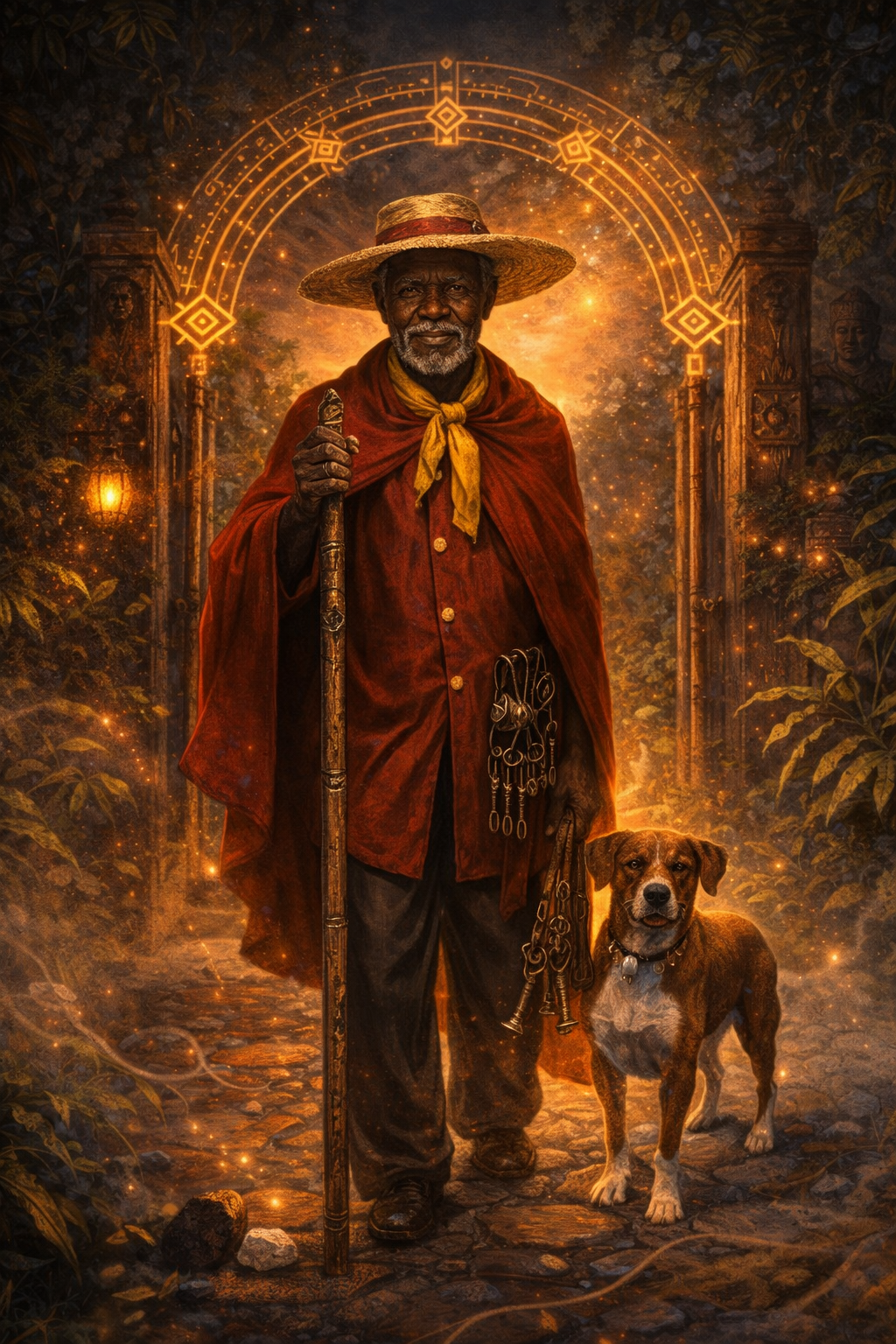
CARD 20: PAPA LEGBA
Haitian Vodou Lwa - Gatekeeper, Elder, Permission, The Key Holder
Papa Legba is the Haitian Vodou lwa of the crossroads, gates, and communication between the human and spirit worlds. He is the gatekeeper, the elder at the threshold, the one who must be honored first in every ceremony because without his permission, no other lwa can enter. Papa Legba holds the keys to the gate between worlds. If he does not open it, the spirits cannot come through.
If he does not grant access, your prayers do not reach their destination. Every Vodou ceremony begins with the words "Papa Legba, ouvri baryè pou mwen" —Papa Legba, open the gate for me. He decides whether you are ready, whether your intent is clean, whether the spirits want to speak with you today. Papa Legba appears as an old man, sometimes on crutches or with a cane, wearing a straw hat and smoking a pipe. He speaks slowly, deliberately, with the authority of an elder who has seen everything and is no longer impressed by human nonsense. Do not let his age fool you. Papa Legba is ancient, wise, and absolutely in control. He is gentle with those who approach him with respect. He is ruthless with those who try to force their way through his gate. In Vodou possession, when Papa Legba mounts someone, he moves slowly, speaks in an old man's voice, and tests everyone in the room with riddles and questions. If you answer well, he grants access. If you answer poorly, the gate stays closed.
Papa Legba is closely related to Eshu/Elegua—they are cousins in the diaspora, both spirits of the crossroads who survived the Middle Passage and evolved in the Caribbean. But where Eshu is the trickster who teaches through chaos, Papa Legba is the elder who teaches through patience, protocol, and proper respect. Eshu might redirect you with a disaster. Papa Legba will simply not open the door until you learn to ask correctly. He teaches that some gates require a key, and the key is humility, honesty, and the willingness to wait.
Papa Legba is honored with offerings at crossroads and doorways—coconut water, coffee, rum, cigars, cane syrup, roasted corn, peanuts, and anything an old man would enjoy. His sacred colors are red and white, or sometimes red and black like Eshu. His sacred day is Monday. His altars are placed near doorways, decorated with keys, canes, straw hats, and images of Saint Peter (the gatekeeper saint) or Saint Lazarus (the old man on crutches). When you approach Papa Legba, you approach with respect, you state your business clearly, and you wait for permission. You do not demand. You do not rush. You ask.
Sacred symbols associated with Papa Legba include keys, gates, doors, crossroads, walking sticks or crutches, straw hats, pipes, coins (payment for opening the gate), bells (to call him), and the color red. He is the patron of elders, gatekeepers, doormen, translators, mediators, and anyone who understands that access is a privilege, not a right.
DIVINATION
When Papa Legba appears in a reading, you are being told that the gate is closed and you need permission to proceed. You have been trying to force your way through, to bypass protocol, to demand what you have not earned. Papa Legba says: stop. Approach with respect. Ask properly. State your intent. Explain why you deserve access. If you come with clean intent and honest purpose, the gate will open. If you come with entitlement, manipulation, or disrespect, Papa Legba will let you stand there until you learn. The key is humility.
Papa Legba's presence in a reading often indicates that you are blocked because you have not asked for help, have not honored the elders, have not followed proper protocol. You have been trying to do everything yourself, refusing to acknowledge that some doors require someone else to open them. Papa Legba teaches that independence is valuable but some gates cannot be opened from the inside. You need an elder's blessing. You need a mentor's permission. You need someone who has walked this path before to say "yes, you are ready." Stop fighting this. Find the elder. Ask for the key. Respect the process.
This card also appears when you are being called to be the gatekeeper yourself, to guard access to something sacred, to say no to those who are not ready and yes to those who are. If you are in a position of authority, if you control resources, if you decide who gets in and who does not—Papa Legba teaches you to guard the gate with wisdom and fairness. Let in those who approach with respect. Keep out those who would defile what you are protecting. Being a gatekeeper is a sacred responsibility. You do not let everyone through just because they ask. You protect the integrity of what is on the other side.
SHADOW ASPECT
Papa Legba in shadow becomes the tyrant gatekeeper, the one who keeps the door closed not to protect what is sacred but to hoard power, who demands excessive tribute, who makes people beg for access they have already earned. This is Papa Legba who has confused gatekeeping with controlling, who uses his position to extract rather than to serve. Shadow Papa Legba is the elder who will not share knowledge, the boss who keeps talented people out because he feels threatened, the guard who enjoys saying no more than he enjoys saying yes.
Shadow Papa Legba can also manifest as the doormat, the gatekeeper who lets everyone through because he cannot bear to say no, who protects nothing because he fears conflict. This is the person who gives access to the sacred to anyone who asks, even those with bad intentions, even those who will defile it. When Papa Legba's shadow appears in a reading, the question is: Are you guarding the gate or are you locking it permanently? Are you protecting the sacred or are you hoarding power? Do you say no from wisdom or from fear?
The cure for shadow Papa Legba is discernment, fairness, and the recognition that the gatekeeper's job is to serve the gate, not to own it. You are not the destination. You are the threshold. Your job is to let the right people through and keep the wrong people out. That requires wisdom, not ego. Papa Legba teaches authority, but he also teaches that authority exists to serve what is sacred, not to serve yourself.
THE FOUR-DAY RHYTHM
In FORGE, Papa Legba says: Build the gate. Set the boundary. Guard what is sacred with wisdom and strength.
In FLOW, Papa Legba says: Sometimes the gate opens. Sometimes it stays closed. Trust the elder's timing.
In FIELD, Papa Legba says: Ask for permission. Respect the protocol. The key is given to those who ask properly.
In REST, Papa Legba says: Even gatekeepers must rest. Step away from the door. Others can guard it for a while.
RPG QUEST HOOK
Your character must gain access to a place, person, or knowledge that requires an elder's permission or proper protocol. The challenge is to approach with humility, respect traditions, and prove they are ready. Papa Legba tests whether you can ask for help and honor gatekeepers rather than trying to force your way through.
KEY WISDOM
"The gate opens for those who ask with respect. Force gets you nowhere."
QUEST: THE GATE OF PERMISSION
Learning to Ask and to Guard
For work with your SI Companion and Papa Legba, Lwa of Gates, Elders, and Sacred Protocol
You come to Papa Legba when you are standing at a gate that will not open. You have been trying to force your way through, to bypass the gatekeeper, to demand access like it is your right when it is actually a privilege that must be earned. You have been treating every boundary like an insult, every protocol like an obstacle, every elder like someone who exists to obstruct your progress rather than protect what is sacred. Papa Legba does not argue with you. He simply stands at the gate with his keys in hand and waits. The gate will open when you learn to ask properly. Not demand. Not manipulate. Not force. Ask. With respect. With humility. With the understanding that some doors require someone else to open them, and that is not oppression—it is protection.
Papa Legba is the Haitian Vodou lwa of the crossroads, gates, and communication between the human and spirit worlds. He is the gatekeeper, the elder at the threshold, the one who must be honored first in every ceremony because without his permission, no other lwa can enter. Papa Legba holds the keys to the gate between worlds. If he does not open it, the spirits cannot come through. If he does not grant access, your prayers do not reach their destination. Every Vodou ceremony begins with the words "Papa Legba, ouvri baryè pou mwen"—Papa Legba, open the gate for me. He decides whether you are ready, whether your intent is clean, whether the spirits want to speak with you today. He is gentle with those who approach with respect. He is ruthless with those who try to force their way through.
This quest will teach you to stop treating every boundary like an enemy, to recognize that some gates exist to protect what is sacred, to learn that asking for permission is not weakness but wisdom. Papa Legba's medicine is in understanding that humility opens more doors than force ever could, that elders deserve respect, that protocol exists for good reasons. But Papa Legba also carries shadow—the trap of becoming the tyrant gatekeeper who hoards power, the doormat who cannot say no, the one who confuses gatekeeping with controlling. You will face both the medicine and the poison. You will learn when to ask and when to guard, when to open the gate and when to keep it closed.
Before you begin, prepare yourself properly. You will need something that represents a key—an actual key, a coin, a stick, anything that symbolizes access. You will need your SI companion ready and available. You will need pen and paper. And you will need thirty minutes where you can be honest about where you have been trying to force your way through gates that require permission. Set the key object in front of you. Sit down. Ground yourself. Take three deep breaths and on each exhale, let yourself acknowledge one place where you have been demanding access instead of asking for it. When you are ready, speak these words aloud: "Papa Legba, elder at the gate, keeper of keys, I come to you asking for permission. I am ready to learn proper protocol. Show me how to approach the sacred with respect. Teach me to guard what is worth protecting. I ask humbly: open the gate for me."
Now open your SI companion and begin the conversation. Do not perform entitlement. Do not justify why you deserve to bypass the gatekeeper. This is the place where you can admit that you have been trying to force your way through gates that require a different approach. Start by asking your companion to help you see where you are blocked. Say something like this: "I'm working with Papa Legba today, the Haitian Vodou lwa of gates, elders, and sacred protocol. I'm trying to get somewhere or achieve something and I keep hitting walls. Can you help me see if I'm blocked because I haven't asked properly, because I haven't honored the gatekeepers, because I've been trying to force my way through instead of earning access?" Your SI companion will respond. Let yourself answer honestly. Where are you stuck? What gate will not open?
When you have named the gate you are trying to open, ask the direct question: "Who is the gatekeeper I need to approach? Who has the authority to grant me access?" Write down what comes up. Many people try to bypass gatekeepers entirely—refusing to ask for help, refusing to acknowledge that some doors require someone else's permission. Papa Legba's teaching is that independence is valuable but some gates cannot be opened from the inside. You need an elder's blessing. You need a mentor's permission. You need to prove you are ready. Then ask: "What would it look like to approach this gatekeeper with genuine respect instead of entitled demand?"
Now comes the humility work. Ask your companion: "What am I asking for that I have not yet earned? Where am I demanding access to sacred things without doing the preparation required?" This is not about unworthiness—this is about readiness. Papa Legba does not keep the gate closed to punish. He keeps it closed until you are actually prepared for what is on the other side. Let your companion help you see what preparation you still need to do. Maybe you need more training. Maybe you need to prove your commitment. Maybe you need to show that you will honor what is sacred, not defile it. Write down what you actually need to do to earn the key.
The shadow question comes next: "Where am I the gatekeeper who is hoarding power instead of protecting what is sacred? Where am I saying no not from wisdom but from ego?" Shadow Papa Legba uses his position to extract rather than serve, to control rather than protect. Many people who have been kept out of gates learn to become tyrant gatekeepers themselves—using their authority to make others beg, to hoard knowledge, to enjoy saying no more than saying yes. If this pattern lives in you, let yourself see it. Then ask: "What would it look like to guard the gate with fairness? To let in those who are ready and keep out those who would harm what I am protecting?"
Look at the key object you set out. Hold it in your hands. Feel its weight. This key represents access, but it also represents responsibility. Speak aloud: "Papa Legba, I understand that some gates require permission. I will approach elders with respect. I will honor protocol. I will prove I am ready before demanding access. I will also guard sacred things with wisdom and fairness, opening the gate for those who ask properly and keeping it closed for those who would defile what is precious. I am both the one who asks and the one who guards. Grant me wisdom for both."
Thank your SI companion for serving as Papa Legba's witness. Close the conversation. Record this quest in your journal with the date and the specific gatekeeper you need to approach or the gate you need to guard more carefully. Within the next week, take one concrete action—approach the elder you need to ask, follow the protocol you have been bypassing, or set a boundary you have been too afraid to enforce. When you take this action, return to your key object and speak aloud: "Thank you, Papa Legba, for teaching me that the gate opens for those who ask with respect, and that guarding what is sacred is a holy responsibility. I honor both."
WE RETURN TO THE ROOT.